Audeze Maxwell Review – Planar Magnetics FTW

Audeze is known as a high-end headphone manufacturer, utilizing unique planar magnetic technology in massive drivers that deliver audiophile-quality sound to your ears. Such advanced tech naturally comes at a premium compared to average headphones – Audeze’s only other (current) gaming-centered headset, the LCD-GX, comes in at around $900 USD. For those of us who don’t want to or can’t drop nearly a grand on some audio equipment, Audeze has launched the Maxwell, which come in at a more manageable (but still premium) price point of $299 USD. We’ve spent plenty of time with their latest gaming headset, and have our review ready now.
Large and in Charge on Your Head
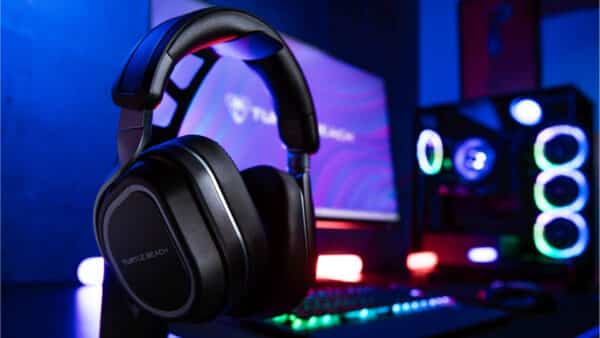
There’s no getting around it, but the Maxwell is a hefty headset. Tipping the scales at 490g, that’s over a whole pound of extra weight atop your noggin whenever you wear it. While this won’t be a problem for vsome of us, for others this may be the most physically tiring pair of headphones you’ll ever own. If you can put up with the weight, though, then it’s not uncomfortable. I wear mine for most of my business day, and don’t really feel tired from the extra weight. An adjustable inner headband can be adjusted to three different heights for a better fit. It’s made of leather and appears that it should hold up over the long-term.
In the box is the headset itself, a detachable hyper-cardioid microphone with included foam filter (though the headset does include a built-in mic, no boom required), a USB-C wireless dongle, a USB-C to USB-A adapter in case you’re running low on the USB-C ports (even the PS5 only has the one), a lengthy USB-C to USB-C cable, a quickstart gujide and warranty card, and even a 3.5mm analog cable for good measure.
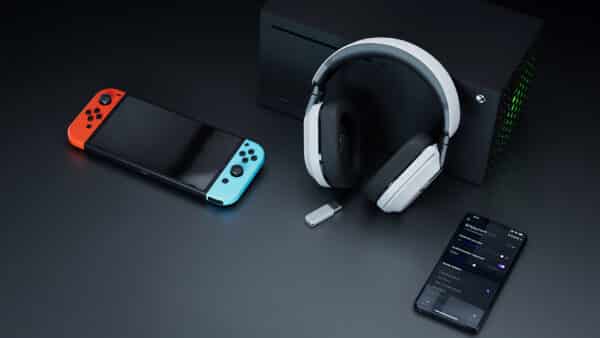
Connectivity-wise, it’ll be hard to find a device that the Maxwell won’t connect to. A 3.5mm cord can be used, however due to the nature of the planar magnetic drivers, unless you’re using a higher-quality cable, they are more susceptible to interference from nearby electronics. At least, that was my experience when I tried using a basic auxiliary cable. Next up, Bluetooth is supported, and in fact you can have the headset connected to your console and your phone at the same time, so that you can easily answer a call if one comes in while you’re gaming, without taking your eyes off the screen. Lastly, a USB dongle enables use of a proprietary wireless protocol, with the usual purported benefits of decreased latency, better range, and more.

Gaming-Centric Features
As these headphones are geared towards gamers, there are a couple of things found on the Maxwell that you won’t usually find on regular consumer headsets. The controls all sit on the left earcup, including two wheel dials: one for overall volume, and another to manage the mix between any voice chat you might have going on, and the game or app you’re running. Double-tapping the mix wheel toggles the audio passthrough mode, which allows you to hear your surroundings as your regular audio plays through. This is an especially handy feature when gaming in VR, as you can hear when someone is talking to you almost as well as if you weren’t wearing any headphones at all. That is because both the onboard mic and attachable boom mic are of a high quality – everyone I spoke to using the Maxwell said I sounded very clear. There is also a dedicated button to toggle between different mic cancelation AI modes, which can help to better isolate your voice against background noise.
The Maxwell automatically detects whenever the dongle is powered on nearby, and says so when it connects to either the dongle or Bluetooth. The dongle is USB-C, though it comes with an adapter for regular USB-A ports as well. Pairing is intuitive and quick, and the headset will automatically reconnect to its last-paired device when turned on. Lossless audio codec LDAC is supported, and the setting sticks around if you disconnect. Note that any calls’ audio overrides the audio coming in from the connected phone, which makes sense but could’ve been boosted by a way to balance both audio feeds at the same time.

Planar Magnetic Drivers Deliver Accurate Audio
There’s a reason Audeze is world-renowned in the audio industry, and it’s for their accurate planar magnetic drivers. These are huge units, at 90mm in diameter. While it’s probably not an apples-to-apples comparison, drivers of this size represent an 80% increase compared to other high-end dynamic drivers, which usually top out at around 50mm. The thinking is that the larger the driver, the better the frequency response, because more air can be physically moved by the diaphragm.
What this results in is a very accurate sound profile. With a frequency response of 10 Hz – 50 KHz, there is little audio out there that these headphones can’t play, and play accurately. However, while this profile is accurate, it might not excite the bass lovers amongst you. But with an emphasis on accuracy, Audeze has tuned the Maxwells to not overwhelm the soundstage with excess levels of bass. That being said, there is still superb sub-bass on the Maxwell. As an example, I am very familiar with Daft Punk’s final album, Random Access Memories. On either the original or the remaster version (not the kinda-smells-like-a-money-grab-or-contractual-obligation Drumless edition), a couple of those songs revealed extra parts to themselves that I had never heard before, such as Touch having a massive-sounding sub-bass component that alerted me to a whole new feeling as the song reached its end.

Unreal Battery Life
Finally, it should be mentioned that the battery life on the Audeze Maxwell is incredible. Quoted at 80 hours, it seems to get around that, as time between needing a charge is measured in weeks, not days. I kept LDAC on, which presumably chews through battery a touch faster because more data is being sent, and thus, more energy consumed. Yet, the headphones didn’t need a charge in well over a week. Charging also only took around two hours. All of this makes sense when you consider the Maxwell has a massive (for headphones) 1800 mAh battery. Perhaps this is a benefit of not trying to keep a design thin and light – there’s more room for power!
At this price point, there is a surprising amount of competition, not only from other gaming hardware manufacturers, but also from some audio industry competitors. For instance, Beyerdynamic makes the MMX 200 for about the same price. Yet its drivers are regular dynamic-type with a standard response range, an estimated 35 hours of battery life, and no high-resolution Bluetooth audio codecs are supported. Other competing products may include LDAC support or extended frequency response as well, but no other wireless headphone in this price range has an 80-hour battery life, and they all use traditional dynamic drivers. If you’re looking for a unique sonic experience, then it may be worth it to go with Audeze for their novel technology.

A Phenomenal Experience
Personally, these have become my daily drivers, replacing my Sennheiser HD58X Jubilee headphones. The accurate sound profile ensures I hear every aspect of whatever I am listening to. While I do occasionally miss the amped-up bass from some of my other headphones, the feeling is always fleeting and when I hear something I’ve not heard before on a song I thought I knew everything about, it reminds me of the benefits to such an accurate audio profile. It’s fun to listen to tracks I know like the back of my hand, and see what secrets can be revealed with another play. For gaming, the stellar response range ensures I can stay immersed in whatever I am playing, or alternatively if I need to hear my surroundings I can enable the audio passthrough and no longer need to be concerned about not hearing when I am needed away from my game. A crystal-clear boom mic and decent-enough built-in mic make taking calls or getting on Discord easy, too.
Audeze has managed to produce a well-thought-out, reliable set of wireless headphones that don’t compromise on audio quality. Multiple connectivity options, including analog, Bluetooth, and proprietary wireless ensure you can likely connect these to any device you own. A wide frequency response range couples with massive, accurate 90mm planar magnetic drivers to produce audio that is nearly reference quality. However, such an accurate sound profile will be unlikely to please bass fans or those looking for a more fun-sounding signature. However, as these are targeted towards gamers who want every edge they can get in virtual competition, having such an accurate sound stage should be seen as a good thing. If you have room in your gaming budget to splurge a little on a nice, accurate set of headphones, it’ll be difficult to beat the Audeze Maxwell.
Score: 9.5/10
Pros:
- Sweeping frequency response range
- Planar magnetic drivers deliver incredibly accurate audio
- Fantastic sub-bass response
- Phenomenal battery life
- Great gaming-centered features
Cons:
- Very heavy
- Sound signature may disappoint those used to more bass emphasis
Audeze Maxwell review unit was provided by the manufacturer. You can read MP1st’s review and scoring policy right here.
This website contains affiliate links. If you click a link and make a purchase, we may earn a commission at no additional cost to you. This helps support our work. Learn more on our affiliate page.