Braid Anniversary Edition Review – Revisiting the Past

Xbox Live Arcade for the Xbox 360 was revolutionary at its time for helping to bring more indie games to home consoles than ever before on top of a slew of other titles. This led to numerous standout titles like Geometry Wars and Castle Crashers, as well as ports of games that were not easily accessible otherwise like Marvel vs. Capcom 2 and Castlevania: Symphony of the Night. One of the standout indie titles at the time was the puzzle-platformer Braid, which subsequently received a port on PlayStation 3 and PC, but hadn’t been available elsewhere in the years since until now with the release of Braid Anniversary Edition.
Setting the Stage
Braid’s story follows the protagonist named Tim as he’s trying to rescue a princess from a monster, but not everything is as it seems. The entire narrative itself is a big spoiler, so I will hold off going into further details besides saying that the story is told through books you come across between each world. Each book that you walk past gives you a little more of the overall story from Tim’s perspective, talking about his past history with the girl he’s trying to save and letting you learn more about their relationship as the game unfolds before culminating in a very unique fashion for the ending.
The gameplay in Braid was unique at the time and is still a game that takes a lot of strategy and thinking to complete. This is because each world introduces a new mechanic that you must utilize to advance further, with them getting more and more complicated. An interesting tidbit is that the first world you enter is actually known as World 2 and then you go from there. However, it would also be a spoiler to explain why and how this works in a more detailed sense.

After reading the text from the aforementioned books leading into each world, you will enter the world proper with a puzzle before you to solve. The first area in each world showcases a different style ability that you have to learn and master, with the first of these being Tim’s most important tool of all, the rewind feature. At any time, you can hold down Square on PS5 and rewind time, including the ability to speed up to 8x speed in the reversal. This means you will never truly die in the game, as you can always rewind, but more importantly, it is used to solve an array of puzzles throughout the game. While some of these puzzles must be solved to advance directly, the majority of situations you need to use the ability to earn the jigsaw puzzle pieces scattered throughout each world.
Within each world, there are 12 total puzzle pieces for you to find. You can technically make your way through the game without collecting all the pieces, but you need to get all of them to reach the game’s ending. Each piece is typically placed in a hard-to-reach location that requires the use of that world’s ability to collect it. The different abilities that you can utilize as you get into later worlds are very creative and easily can leave you stumped for a bit.
World 3 introduces items and places where time isn’t affected, which means you can manipulate time differently around you to get to certain places. One of the more difficult mechanics comes in World 4, where time begins to be affected by your movement. Standing still means any enemies or obstacles stand still, while moving right and left cause everything to move forward or backward in time respectively except for Tim. This is one of the most difficult abilities to master, as it takes a lot of trial and error to figure out the best way forward while also collecting all the puzzle pieces. World 5 adds a shadow version of Tim that recreates your movement after you rewind, which can be used to your advantage. Lastly, World 6 gives you a ring that slows down time around you, allowing for further jumps and the slowdown of projectiles especially.
Near the end of each stage, but sometimes a bit earlier, you’ll come across a board where you can start to put together the puzzle pieces. You can also wait to put the puzzle together in the main hub of Tim’s House, which lets you travel between each world as well. One puzzle piece early on even requires you to put part of the puzzle together to use it as a platform to get another puzzle piece. I thought this was very innovative and was left disappointed that this was the only time they were used this way in the main quest.

Beyond the main story, there are also eight stars for you to find, and they are very well hidden. In fact, it’s quite likely you will not even come across these without using a guide of some sort. Even worse, one of them can only be reached if you have not put all of the puzzle pieces in World 3’s puzzle together so you can use individual pieces as stepping stones in Tim’s House to get it. This is why I recommend just looking up a general guide at least for how to obtain these or else you may find yourself having to replay the entire game. Even with the game being very short, I still think there should be a way to break up the puzzle pieces after completing them for this very reason, as it’s kind of cruel to have one missable star entirely like this just for doing what you think you’re supposed to do by completing the puzzle.
New Additions
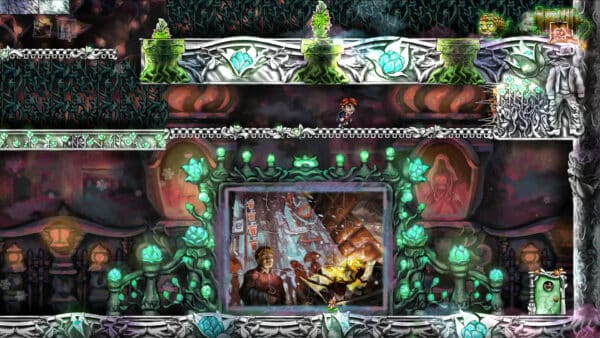
Braid still holds up incredibly well with its unique gameplay, even as someone who beat the game back in 2008 when it was originally released. Thankfully, this new release is not just the original game ported with no extra features or upgrades. In fact, there are quite a few in Braid Anniversary Edition, starting with the visuals of the game. Rather than just upscaling the game and calling it a day, the development team instead remade the game pixel by pixel with an updated art style and new animations that look fantastic. It is not a drastic change from the original to where it changes the aesthetic but rather is just a better-looking version of the original.
For those who do not care for the modern visuals, you can quickly swap back to the original visuals by pressing in on the right analog stick at any time. This was always something I loved in Halo 2: Anniversary as a way to see the difference in art between the two versions right away instead of through a menu, with it being just as seamless here. The music has also been upgraded and sounds better than ever as well.
In one of the most innovative uses of commentary I’ve ever seen, Braid Anniversary Edition has added an entirely new world based around the commentary where you get to listen to over 15 hours of developer commentary from Jonathan Blow while exploring old puzzles and also completing some brand new puzzles exclusive to this version of the game. This commentary by Blow is very detailed and gives excellent insight into the development of the game and the thought process behind certain decisions. Braid is Blow’s baby and you can tell with the amount of love and care this commentary and the release as a whole exudes.
The commentary is even split into different categories such as programming, design, and visuals, allowing you to choose the order or even what you want to listen to at all. Leaving a level with commentary will cause it to pause and then will resume upon your return, which is a great feature that allows you to play around and not have to constantly worry about where the commentary is if it was reset.

The majority of the commentary has you revisiting old puzzles with new details on how they were designed and the like, but some of the doors you enter in the commentary world will take you to alternate versions of previous levels or new levels entirely with a puzzle piece icon. This means there is a new puzzle piece for you to collect in this area, with some of these being even harder than the main game. Adding numerous new puzzles was a nice touch to provide people who have already played the game or even those who powered through the short main game for the first time with additional content to consume.
Braid Anniversary Edition is a good example of it being very hard to mess up a great thing, which Braid itself already was. Every change or addition in this remake was for the better, as the game itself was not just updated superficially, but also received new content for players old and new to experience. The original Braid still holds up well today as one of the best puzzle-platformers ever made and now Braid Anniversary Edition continues to prove that in this stellar remake.
Score: 9.5/10
Pros:
- Innovative puzzle design
- Upgraded visuals and sound
- Can switch back to the original visuals seamlessly
- New commentary world adds insight and new puzzles
Cons:
- Missable star issue still requires total restart to obtain
Braid Anniversary Edition review code was provided by the publisher. You can read MP1st’s review and scoring policy right here.
This website contains affiliate links. If you click a link and make a purchase, we may earn a commission at no additional cost to you. This helps support our work. Learn more on our affiliate page.