Dragon Quest I & II HD-2D Remake Review – A New Reimagining

Dragon Quest fans were really excited to see the release of Dragon Quest III HD-2D Remake last year, which was very well received and left people wanting even more. With the first three games in the series being known as the Erdrick trilogy, it might have seemed weird to release the remake of the third game before the other two. However, this is because the third game is a prequel to the first two, so it makes sense chronologically here. Now the first two games in the trilogy have arrived in one package as Dragon Quest I and II HD-2D Remake.
The HD-2D Trend
HD-2D remakes have become a very popular way to design games that aim to feel like they are from the 16-bit era, or are remakes of games from that era or earlier, that want to maintain sprite animations. Square Enix was the pioneer of this design with Octopath Traveler back in 2017, and they followed that up with new games like Triangle Strategy and Octopath Traveler 2 as well. They also utilized this on the Live A Live remake and Dragon Quest III HD-2D remake, so it only makes sense they would continue that style as they did in this collection.
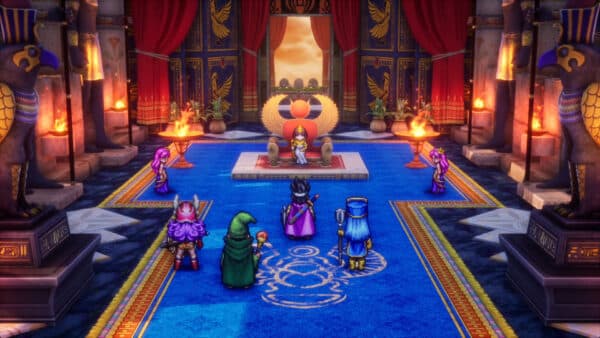
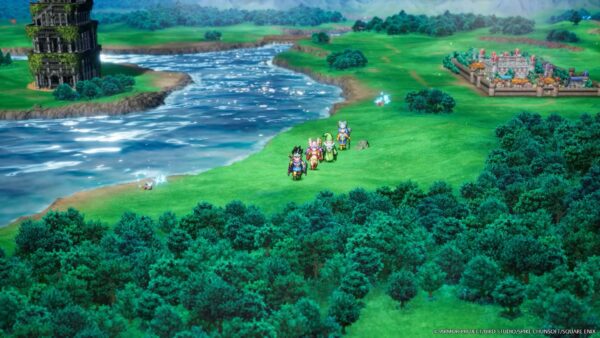
Dragon Quest I and II HD-2D Remake continues the trend of gorgeous-looking HD-2D games, looking just like its predecessor last year. The backgrounds are beautifully rendered, and the colors of the sprites really pop as they move across the screen and in battle. Considering that both of these were originally 8-bit games on the NES, it’s really incredible how much of a facelift these games have received through HD-2D while still maintaining the core level design.

The original Dragon Quest was released in 1986 for the NES, followed by the sequel Dragon Quest II in 1987, and then Dragon Quest III in 1988. Even though these games were only a year apart, they are far from just the same game with more content. In fact, each subsequent entry introduced some new gamechangers to the franchise that really have helped to impact the RPG genre as a whole.
When you first fire up the game, you have the option to pick between Dragon Quest I and Dragon Quest II on the main screen, so you can dive right into the second game if you so choose, though I strongly recommend playing the first game first. Upon picking your game of choice, you also get to decide upon which difficulty level you’d like. Dracky Quest is the easiest difficulty and allows you to focus more on the story and not have as much trouble in battle. Dragon Quest is the normal setting, and it is pretty standard. Lastly, Draconian Quest is the hard mode where not only are enemies stronger, but you also earn fewer experience points and gold coins. I personally feel that Dragon Quest is the perfect balance here for both games, but you can choose to go with whichever difficulty is best for you.
The Story Begins
Dragon Quest I takes place years after Dragon Quest III, where Erdrick had saved the world against the Lord of the Underworld and brought peace to Alefgard. The game begins with the Dragonlord rising and wreaking havoc upon Alefgard. The main protagonist that you play as is a descendant of the hero Erdrick, so you have the heroic blood in your veins and must take down the Dragonlord and bring back peace to the land. Being an original NES game in the first place, the story here is pretty basic for the most part, but it is still quite enjoyable to experience as you play through. I also still love the ending here, as it’s not just a by-the-book type of ending you would come to expect.
In addition, this new version adds to the story with different quests that help to flesh out the world. The world of the fairies gets a major plotline throughout part of the game for one, while you also get introduced to what are now series staples like Robbin’ ‘ood as part of the main story now too. Not only does the extra content flesh out the story itself here, but it also extends the length of what was a pretty short game into a good bit longer here.

One of the biggest complaints fans and I have had about the first Dragon Quest was that it required way too much grinding to advance the story. While there wasn’t that much story to be found throughout back then, you spent a lot of your time just grinding for XP through battles to make yourself ready for what was to come or you would get destroyed by the enemies. While this game still requires a good bit of grinding at times, the extra content scattered throughout has helped make the grind a little less apparent and required, since the enemies are more gradually leveled than before.
Something that sets Dragon Quest I apart from most RPGs that you have likely played is that you are given one player in your party, and that is all that you will have in your party for the entire game. As the story had only the descendant of Erdrick going on this quest, I am glad this was not changed just to modernize it and better align with future games. Instead, this game feels rather unique as a result where you have to worry about building one character and one character only. There is only one character you can attack with, and there is only one character that enemies can attack, you. This does make things quite a bit harder from the start until you level up further, though even then it can get difficult, which is why the aforementioned grinding is often required.
Dragon Quest II followed up the original game with a story that took place generations later, as we follow the descendants of the hero from Dragon Quest I, and also, in turn, Erdrick. In this time period, three new kingdoms have been formed by the descendants, but now darkness has come for their world yet again, with the villainous Hargon arising. This means that the bloodline must come together to fight darkness and save the world once again.
The major change found in Dragon Quest II was that you not only have just a party of one, but a party of three that included the Hero and his cousins, the Prince of Cannock and the Princess of Moonbrooke. This new version though changes things up greatly by increasing that party size to four by including the Princess of Cannock as well. In the original version, she was viewed as too young and not allowed to be part of the quest to defeat Hargon, but this version wisely adds her into the mix to match the party size found in Dragon Quest III. Having these extra party members not only greatly helps make combat less difficult at times than in the first game, but also adds to the story, as they are all directly involved in the main plot. I found this much better than how Dragon Quest III even does it, which I mentioned in my review for that HD-2D remake where the custom created party members felt useless outside of combat since they were not tied into the main plot. I will always prefer pre-designed party members in a game like this compared to custom-created party members, like in III and IX, notably.

Familiar Gameplay
If you have played Dragon Quest III HD-2D Remake, you should pretty much know what to expect from most of the gameplay and how the game itself is structured in Dragon Quest I and Dragon Quest II. The game features a world map you must traverse to visit towns, caves, shrines, and more. If you would like, you can have the game mark on the map where you are supposed to go next, which is quite helpful. Otherwise, you will be reliant on the Objectives list found on the pause menu to tell you where you are supposed to go, which you can also turn off if you want to go completely blind.
Traveling across the map feels pretty good, as you can walk or run at any time. There are some obstacles to prevent you from going certain paths, as well as some hazards like poison ground that you have to use spells to get across if you don’t want to get poisoned. Whether on the world map or within the various locations that aren’t towns, you will have random encounters with enemies for that respective area. These enemies come in groups and can often overwhelm you if you are not prepared.
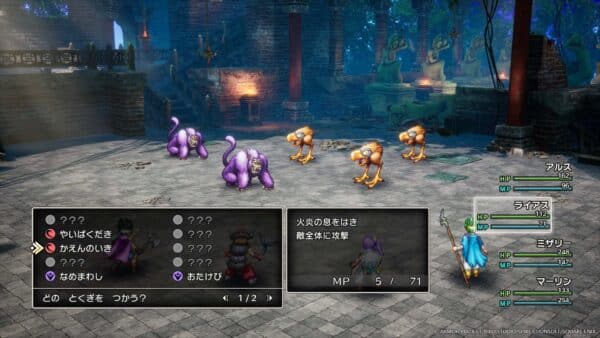
Dragon Quest I is one of the games that made the turn-based RPG popular in the first place, and the combat is still pretty satisfying today in both games. You and the enemy alternate, taking turns against one another, with the speed of your characters and the enemies deciding how many attacks and such can be done at a time. You will often come across enemies that can attack you twice for every one attack you land, so be prepared for that. When playing Dragon Quest I, you can very quickly get overwhelmed due to the speed of enemies, while having a party of characters in Dragon Quest 2 does alleviate this a bit.
As per the norm in Dragon Quest, the enemies are grouped by types and often by where they are located on the battlefield. This allows you to attack multiple enemies at once with certain attacks, while also still being limited to these groups. When it’s your turn, you have the options to Fight, Tactics, and Flee. Flee is always a good option if you are close to dying and do not want to get a game over, though it doesn’t always work the first or even second time if the enemies block your way. Tactics allow you to set up attacks and auto-battle, which I never found myself wanting to do.

Choosing Fight is where the combat really opens up, as you have the options of Attack, Spells, Defend, Abilities, Items, and Equipment. Attack will do a general attack based on the equipped weapon that you have. Spells allow you to use any spells that you have learned by consuming MP, including the staples like Sizz, Fizzle, and Heal. Abilities take this a step further and let you use special abilities like Flame Slash, Dodgy Dance, Dragon Slash, and more using MP as well. You have to be very careful, though, because using a mix of too many Spells and Abilities can quickly drain your MP, and that will quickly lead you down a road you don’t want to be on when stuck in a dungeon somewhere. Defend lets you defend for a turn and reduce the damage of incoming attacks, but I felt like this wasn’t worth using too often, except in special cases. Items allow you to use any items in your character’s bag to do things like heal or even attack the enemy. Lastly, you can equip something different in battle with Equip, though I don’t recall ever using this one in battle.
Characters in both Dragon Quest I and Dragon Quest II will level up as you earn XP and learn new spells and abilities, but that is not the only way to obtain new spells and abilities. In fact, there is a new way in the game to obtain exclusive skills that can be very handy. Dragon Quest I and II HD-2D Remake introduces what are known as Scrolls, which you will find in treasure chests. Upon finding these scrolls, you can use them on your characters to teach them a specific skill that they will now be able to use from that point onward. I thought this was an interesting way to introduce some spells and abilities that you can choose to build your party around in II, especially.
One major quality of life inclusion here is that you can choose the battle speed at any time by pressing L or R to switch between Normal, Fast, and Ultra-Fast. With the game being turn-based, this helps immensely and prevents it from feeling dragged out. Unlike some of the Final Fantasy remasters over the years that actually added an overall in-game speed up, this here is specific to battle. You can also fast forward through conversations separately, but you have to activate it manually.

A Dragon Quest staple has always been to go to the church in the game to save, purify curses, and such. While this is still the only way to save manually, Dragon Quest I also has the amazing auto-save to save you at times. As mentioned, Dragon Quest I has a steep difficulty curve at times, where you have to grind to level up, but you won’t always know when that difficulty is going to creep up quickly and lead to your death. Rather than throwing you back to the last church you saved at, you can always utilize the auto-save that seemed to pretty much save after every battle or so that I found. For purists, you can still just choose to only load the manual saves and avoid the auto-saves altogether, but it’s an incredible help in a game like this to have auto-save included.
Another carryover from Dragon Quest III HD-2D Remake is the introduction of full voice acting. This isn’t just for stray voice lines at certain points, but is used quite a bit in the game, especially when the story is involved. This does not mean that every single line in the game is voiced, as they definitely are not, but there’s still a lot of it to be found. Once again, this adds so much more to the game’s immersive factor by not just featuring voice acting, but really top-notch voice acting.
Verdict
Dragon Quest I and II HD-2D Remake is just as good as expected by taking the same engine designed for Dragon Quest III HD-2D Remake and remaking the first two games in it. These remakes have come with not only a fantastic visual upgrade, but also additions to the story and gameplay that make the games better than ever. Making these classic RPGs more accessible than ever is a real treat and you can tell they were done with a lot of love and care and not just as a quick cash grab after the success of the remake of III. Dragon Quest 1 and 2 HD-2D Remake once again confirm that HD-2D really continues to be the best way to revive older RPGs like this from the 8-bit and 16-bit eras, and I really hope we see more from the Dragon Quest series and maybe even extend to other series like Final Fantasy as well in the future.
Thankfully, the next remake isn’t that far off, as Dragon Quest 7 Reimagined is due for release on Feb. 5, 2026.
Score: 9/10

Pros:
- HD-2D visuals are beautiful
- Expanded story and more fleshed out characters
- Fourth party member in Dragon Quest II
- Addition of voice acting
- Auto-save capability
Cons:
- First game especially is still a little too grindy at parts
- Games definitely stick to classic style, so might not be for everyone
Dragon Quest I and II HD-2D Remake was provided by the publisher. You can read MP1st’s review and scoring policy right here.
This website contains affiliate links. If you click a link and make a purchase, we may earn a commission at no additional cost to you. This helps support our work. Learn more on our affiliate page.