Dragon Quest VII Reimagined Review – Retro Remade

Dragon Quest VII is over 25 years old. In fact, it has already been remade once before, for the 3DS. For this second remake, everything has been rebuilt from the ground up with modern sensibilities in mind.
Launching just a few months after the recent success of Dragon Quest I & II HD-2D Remake, can Square Enix continue mining their older franchises for gold? Read our Dragon Quest VII Reimagined review to see why that seems like as solid a plan as any!
Crisp Environments, Runs on Anything
As with so many other remakes these days, the Unreal Engine was chosen to do the heavy lifting. It does so with ease. Dragon Quest VII Reimagined should run on just about any computer you might have; with minimum specs quoting such ancient parts as a 6th-gen i3 and a GTX 750, almost everyone will be able to enjoy this remake.

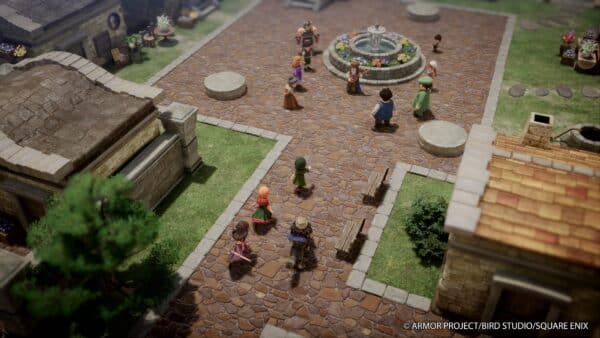
The game’s new diorama visuals are charming, with crisp environments, interesting and colorful enemy designs, and a high, consistent frame rate throughout. Some of the overworld sections have a very narrow field of view, resulting in a big chunk of the world out of focus. It kind of reminds me of the overworld of Expedition 33: Clair Obscur, but with doll proportions to the characters, which is obviously intentional.
Dragon Quest VII is very cinematic, and plays a lot of homage to classic RPGs of the era. All cutscenes are fully animated and voiced, and done so quite well in either audio language. Square Enix used actual physical dolls which they scanned into this remake, and the effect is this interesting look where their movement and expressions look and feel like a Pixar movie.
An Epic Score
A full soundtrack accompanies Dragon Quest VII Reimagined, and you know you’re in for a treat from the very first cutscene. A sweeping orchestral soundtrack makes even picking up a basic item sound like an event. While some of the background music can get a tad repetitive after some time, the landscape and scenarios change frequently enough that most songs won’t overstay their welcome.
The original Dragon Quest VII offered over 100 hours of gameplay before you’d seen everything the game had to show you. This time around is no different, but it is easier to stay on-track and only play the main campaign. Having said that, realistically you’ll probably still need to set aside several dozen hours if you plan on at least seeing the credits.
Most of the core of the original Dragon Quest VII has been retained in this remake. One of the largest changes is in how the vocation system works. Vocations are specialized classes, which offer different battle strategies and allowed only certain characters to learn certain skills, such as a Priest learning healing moves, or a Warrior learning more powerful attacking skills. In Reimagined, a new Let Loose command has a chance to activate, seemingly randomly. Once ready, the character who is ready to let loose is surrounded by a blue aura, and they can perform the command whenever it’s their turn during a fight. What exactly the command does depends on what a character’s vocation is. For instance, the Hero’s initial vocation is Fledgling Fisherman, and his Let Loose ability is called Ocean’s Devotion. Its effect is that each ally sees the next attack against them completely neutralized. This can be timed such that everyone can take a chance to heal without taking any damage, or at least lessening it in the event that they are attacked twice in a row.

Experiment; It Won’t Hurt
Dragon Quest VII Reimagined doesn’t explain everything to the player; you are expected to experiment and figure out how things work on your own. Take the aforementioned vocations; the skills learned while one character has it set as theirs are exclusive to that vocation. Characters can expand their available skills by mastering these vocations, which level up using a different XP track as compared to each character’s main level. But to add variety to their skillset, characters can also moonlight as a secondary vocation. As an example, a character with a Pirate vocation has the opportunity to learn the Flying Knee skill, but only if they moonlight as a Martial Artist. This serves as a way to keep skills unique to certain vocations, and also as an incentive which rewards players for combining two vocations that they might not otherwise have considered.
While a lot of Dragon Quest VII has been, well, reimagined, some remnants of the past remain. While the game has background auto-saves that occur each time you enter or exit a location, that doesn’t mean manual saves are out of the question. Saving manually can only be done at certain locations, such as churches in a village or Sacred Statues, just like in the original release. Generally, you won’t lose much progress even if you abruptly quit the game, even if you don’t take advantage of any save spots before venturing forth into a dungeon or new region.

Streamlined Story and Fights
Some other things have been streamlined in Dragon Quest VII Reimagined. Many quests have had some portions removed, which can cut down on the time spent tediously traversing across an island on what are essentially fetch quests. Enemies are also visible in the overworld, and as with most RPGs if you can press the attack button as you approach them, then you’ll begin the battle with an advantage. Once you level up enough, this single hit can take out one or more enemies in a single hit, and you’ll receive the same rewards as if you had bested those enemies in a regular turn-based fight.
For long-term fans of Dragon Quest VII specifically, there are extra scenarios which fill in some backstory of some of the main characters, such as a peek at both the Hero’s and Maribel’s childhoods, a story involving an older Kiefer, and other tweaks done in the interest of a more streamlined experience. The end result is that, provided you stick to the main storyline, it rarely feels like you’re doing busy work when progressing through the adventure.
Pros
- Diorama-style visuals are charming
- Character visuals are enhanced by their real-world doll roots
- Sweeping soundtrack adds to the onscreen drama
- Streamlined story helps you progress more quickly than before
- Fleshed-out character backstories should please veterans of the original

Cons
- DLC feels odd in a game originally introduced 25 years ago
- Classic turn-based gameplay may be too slow paced for some
Dragon Quest VII Reimagined was provided by the publisher. You can read MP1st’s review and scoring policy right here.
This website contains affiliate links. If you click a link and make a purchase, we may earn a commission at no additional cost to you. This helps support our work. Learn more on our affiliate page.