Elden Ring: Nightreign Network Test Impressions – Feeling Hollow

[summaraize]
I can’t put too fine a point on the fact that FromSoftware’s Elden Ring was far and away my favorite game of 2022, and its DLC, Shadow of the Erdtree, was my favorite release of 2024. When FromSoftware and Bandai Namco announced Elden Ring: Nightreign at last year’s Game Awards, I have to admit, I wasn’t immediately sold. The idea of having to choose from a selection of eight “hero” characters, each with their own special and “Ultimate” abilities, and doing “runs’ on an ever-shrinking map to fight bosses was not at all what I wanted from the next Elden Ring title.
However, I was fortunate enough to get a code from Bandai Namco for the recent Network Test on PlayStation 5. After three Network Test sessions, which lasted about six hours in total, I have to admit that I’m still not sold on it. Only this time, it’s not just about the idea of what it is but rather about having experienced it for myself.

A Cooperative Soulsborn Built on Hero Classes

As a quick overview of what a match consists of, three players chose a “Nightfarer” (hero) to enter the map, hit various points of interest for weapons and consumables, fight enemies/minor bosses, gain runes, level up, move on to the next point of interest and repeat, all while the “Nightreign” closes in around the players, funneling them to a final boss of the first (of three) respective nights. Once that night boss is defeated, the next day begins, and the cycle repeats until you get to the night two boss. Once that boss is defeated you enter a sort of portal that takes you to the Nightlord boss of that session. Once that boss is defeated, the match ends, and players will be dropped back at the Roundtable Hold to do some things I’ll discuss later.
This preview is solely based on the Network Test and my experiences in my play sessions. My first session began in an alternate version of the Roundtable Hold from Elden Ring. The most notable difference is I was able to venture outside to a “sparring grounds’ where some text targets are set up to let players get their bearings on the new controls/combat. The basic combat for light and heavy attacks is mapped to the R1 and R2 buttons, blocking is mapped to L1, and the respective weapons, Ash of War, are mapped to L2. Left and right on the D-pad cycle through weapons. Jump is still X (I refuse to say “cross’), and sprint is still the circle button. With the game being designed around speed, gone is the crouch button mapped to L3, and instead, L3 is a super sprint.
The differences don’t just end here. Square is solely for your Flask Cerulean Tears, and consumables are used by pressing up on the D-pad while pressing down cycles through the four consumable slots. The biggest change to the combat is the special and ultimate meters on the bottom/center of the screen. Each flanks the character and for each character, they do different things. In my sessions I was able to play as all four available characters. For the sake of this preview, I’ll list them in the order I played them.
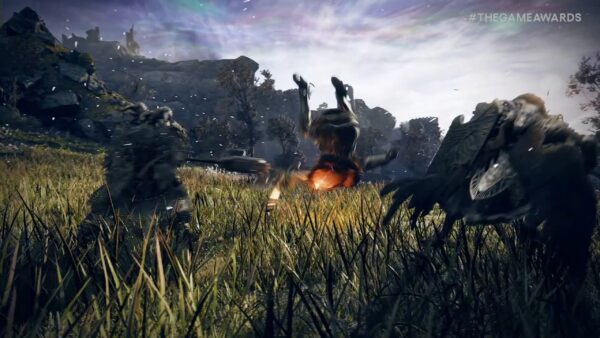
To start a match, I approached the Roundtable and began matchmaking. Unfortunately, the password matchmaking was disabled due to a disastrous first test session where a lot of people weren’t able to connect. Finding a match with randoms was extremely quick. Once a party of three was found, I was taken to the character select screen. In the base game, my first playthrough was a magic build, so I chose the Recluse, i.e., the magic user.
Once her ultimate meter is full by pressing triangle and R2, you’ll be able to cast Soulblood Song, which puts a blood mark on an enemy, and for a short time, attacks of any kind that hit the target replenish Vigor and Focus Points (aka mana). The Recluses character skill is called Magic Cocktail. When an enemy is hit with an element – magic, fire, holy – a colored ring appears on them, depending on the element. Blue is magic, red is fire, yellow is holy. By holding the triangle and L2, the Recluse will siphon that element and store it in one of three tiny circles around a symbol. Once all three circles are full of an element, pressing triangle and L2 again will cast a larger spell that has a different effect based on the combination of three elements that were stored. For example, if all three circles are magic-based, the Recluse will cast a blue light that will circle the target and eventually damage the enemy with multiple magic slashes. Lightning and fire did a thrust of fire and lightning. And a mix of fire and magic casts a bomb-like explosion that has the capability of knocking enemies down if it doesn’t outright kill them. It’s worth noting that every time you siphon an element, it restores some FP, making it entirely possible to never run out. This contributed to Recluse being my favorite character to play.

Next up, I played as the Guardian. The “tank” of the four, Guardian, has a shield and halberd to start, and his abilities are Whirlwind as the character skill and Wings of Salvation as his Ultimate. With Whirlwind, the Guardian sprouts wings and does a whip spin that creates a brief cyclone that can lift enemies in the air, knocking them to their backs and doing damage in the process. Wings of Salvation has the Guardian leap high in the air and come down with a strong AOE attack. Holding triangle and R2 gives the other players a defense buff. Maybe I just didn’t “get it” but this character was easily my least favorite to play. I rarely saw any significant damage done by either skill and, in general, find tanky characters not much fun to play. I admit, this is very much a “me” thing, so take that as you will.
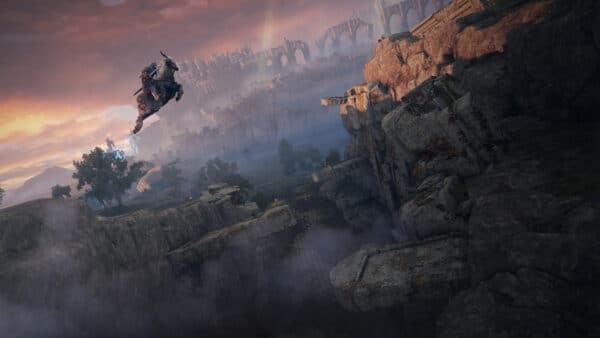

The third character I was able to play was Wylder, who is basically the knight hero and general “all-around” character. Wylder’s passive ability, Sixth Sense, allows him to “cheat death” a single time where he will automatically dodge an attack that would put him into a downed state. Wylders character skill is the Claw Shot. A grappling hook on a 7-second or so cooldown that can be used to pull smaller enemies closer or pull Wylder closer to the larger enemies, including bosses. His Ultimate is the Onslaught Stake which is a thrust out and up attack with a powerful explosion, Admittedly, getting the distance and timing right on this can be finicky at first but once it clicks it’s a fun move to pull off. Wylder seems like a good beginner hero with the ability to automatically dodge a killing blow.

Lastly, I was able to play as Duchess. In simple RPG terms, the Duchess is the “Rogue.” What she lacks in power, she more than makes up for in quickness. Her character skill, Restage, is by far one of the most useful in clutch situations as it allows the enemy to retake recent damage by generating a sort of phantom of the enemy that retakes the damage and applies it to the corporal form of the enemy Timed just right it can make a big difference. For example, you can have the enemy retake critical damage to take double the chunk from the enemy’s health bar. Her Ultimate is called “Finale,” and it basically turns her and any heroes nearby invisible, allowing them to hide from enemies. Either to rush past without drawing aggro or to reposition yourself to get in a critical backstab. Easily my second favorite character to play of the four available in the Network Test.
Gameplay Tweaked for Fast-Paced Action
As mentioned earlier, just like in Elden Ring proper, killing enemies yields runes to be spent to level up. Every Nightfarer begins each run at level 1, and visiting a Site of Grace allows you to level up with one button press. Since the only on-screen “stats” are vigor, FP, and endurance, leveling up simply raises each of these a pre-determined amount per level. There is no choice for paralysis to be had. The choice is made for you and for the gameplay loop of Elden Ring: Nightreign, which is to advance as quickly as possible, it’s one of the smarter design decisions of the game.
Traversal is also simplified. Since Torrent isn’t in the game, his speed is transferred directly to the heroes by pressing L3 for the aforementioned super sprint. Climbing is simplified by double jumping and mantling most surfaces with a ledge.

There are chests throughout the world that contain randomized loot, which will either be a weapon or a passive buff. Generally, these will be better than what you’re already carrying, so it doesn’t take much time to choose. You can either use the weapon or not and move on. Consumables are usually found in crates that glow from the inside. These can be projectiles like pre-crafted cracked pots, throwing knives, or neutralizing blouses to cure status ailments, meat and such that gives temporary buffs, and grease to apply to weapons for added elemental damage. As mentioned before, only four slots are available, so choose wisely. Quickly, but wisely.
There are also churches that have extra flask charges that are worth seeking out as quickly as possible.
When a hero is downed, the only way to help them up is by hitting them, which takes chunks away from the meter above them. Every successive time a hero is downed another purple meter appears above them that needs to be depleted before the ally can get back up and get back into the fight. This is where the Duchess and especially Recluse are the most useful. Duchess’s speed allows for quick hits, and Recluse can lock on to a teammate and raise them from a distance, keeping you out of the fray. If a downed teammate isn’t raised in time, the teammate loses a level upon respawning.
Once the Nightlord of the match is felled, players receive a choice of one gemstone that applies a permanent passive buff as long as the gem is equipped. They’re color-coded, and each Nightfarer has a combination of three gemstone slots. I have a feeling more slots will become available as some of the gemstones available were different colors than the available slots in the test but had clear indications that the gemstone was for a specific hero.

There is also a currency that can be chosen at the end of the match, but at the time of the Network Test, there were no merchants in the Roundtable Hold at which to spend it.
Elden Ring Nightreign can be great fun if you get matched up with people who know what they’re doing. People who know how to use their chosen heroes well, pay attention to their teammates in case they need to be rezzed, and pay attention to the Nightreign circle. Unfortunately, during my sessions, it was all too common to be stuck with the exact opposite of that, including players who disconnected when things didn’t go their way. While successful runs are relatively short, about forty minutes each if you’re successful, it seems paramount that you play with friends. Pinging, at least in the Network Test, was solely used to mark a waypoint on the map. I didn’t see anything else that could be used to silently communicate with teammates. Meaning chat will be very important in most cases. Matchmaking with randoms seems like it will be a total crapshoot.
Another concern I have, and it’s the biggest one, is that I don’t see this game having legs. With passive buffs being the only thing that carries over from match to match, I can see the drive to continue playing drying up for all but the most hardcore fans once the base game Nightlords have been beaten. This, of course, will depend on what is purchasable with the in-game currency and post-launch support. But with DLC already being announced, I don’t see FromSoftware spending time and resources giving free updates.
By the time I played the second available test session, I had already teamed up with at least one player who knew the optimal path for the best results. With only eight Nighlords in the base game, I can see this getting old quickly since progress isn’t really progress. Ultimately, and most tellingly, for me anyway, I didn’t have that urge to get back in there when I wasn’t playing it. Which is an entirely new experience for me as far as a FromSoftware title goes. I felt like I had enough by the time I was done. I am still going to give the full game a shot because there is fun to be had, but so far nothing I played comes close to the thrill and fun of playing Elden Ring. Yes, I know it’s a different type of game, but the fact remains that FromSoftware chose to use the Elden Ring branding and iconography, so comparisons are inevitable and valid.
I guess we will all find out on May 30, 2025, when Elden Ring: Nightreign releases on the PS5, Xbox Series X|S and PC.
This website contains affiliate links. If you click a link and make a purchase, we may earn a commission at no additional cost to you. This helps support our work. Learn more on our affiliate page.