Blades of Fire Review – Forging Your Own Path

While action games are a dime a dozen these days, MercurySteam aims to break from stereotypes as it released Blades of Fire, which emphasizes weapon forging more than most games.
For those wondering, Blades of Fire is not a souls-like, though that doesn’t mean it’s lacking in the challenge department; it’s just a different kind of challenge compared to most souls-like games that have popped up these days. Can MercurySteam recreate the magic the studio weaved in Castlevania: Lords of Shadow? In a way, they did, but there’s so much more to it than a simple yes or no.
Nostalgia Forged in Fire

Like many things you’ll find going on in Blades of Fire, the story sort of throws you into it. It starts with you being some sort of wandering spirit who eventually comes in contact with our main protagonist, Aran De Lira, a blacksmith living in a forest. Like many tales before, Aran hears a cry for help and quickly jumps into action to answer the call. This is where he eventually meets Adso, a companion who joins Aran in his quest to kill the evil queen. That’s the short of it, and honestly, about as much information as we, the player, get with a few more details here and there. You’d probably get more of a story setup by peeking at the official website and reading up on what’s there, but ultimately, the story isn’t something I felt was all too exciting. It’s serviceable, not necessarily good, but also not bad. Aran and Adso’s relationship is fun to see develop throughout the game, but the writing and some of the voice acting aren’t going to leave any sort of lasting mark; at least for me, it didn’t.
I will say, though, that it does have a bit of that old-school PS2-era charm to it, and I think, in all honesty, that’s a nice way to describe the game as a whole. It’s an old-school game that probably would have fit perfectly during the PS2 era, and while that comes with a certain nostalgic appeal, it also brings along some of the less polished aspects of games from that time. But this is sort of what puts Blades of Fire in a rather awkward position, because it’s a game that many will probably feel very different about.
I suppose that could be said for every game out there, but I know a bad game when I see one, and I don’t think Blades of Fire is a “bad” game; I just think you need to go in with the right mindset to understand what it’s trying to achieve. The story, again, is pretty forgettable, but I think where the fun and my enjoyment all lay was in the gameplay and the world crafted. There’s this charm to it, something that again calls back to that era of PS2 games, where even if they weren’t the greatest game, you knew you would have fun with them because of the hook some of those games had. A really cool idea that was done well, but overlooked because of some of the other aspects of the game. A hidden gem, which I feel Blades of Fire will eventually become down the road.
From a gameplay perspective, it’s very Souls-like. You have explorable areas, rest spots, unlockable shortcuts, and enemies that are tough and respawn after dying and resting. The influence is clear, though it does differ in that it has no character leveling. Instead, players will get stronger by crafting new weapons. It fits the role of a Blacksmith, and there’s a whole mini-game that goes along with it that helps determine weapon rarity and quality. You craft these weapons by collecting resources throughout areas, and the higher the rarity, the more powerful the weapons you get. Some weapons are locked and require you to defeat a certain number of enemies with that specific weapon or a mini-boss. Different enemies are also prone to more damage from certain types of weapons and their attributes. There is weapon degradation, which I’m never a fan of, but I do like how much variety there is in them and how many different playstyles you can have.

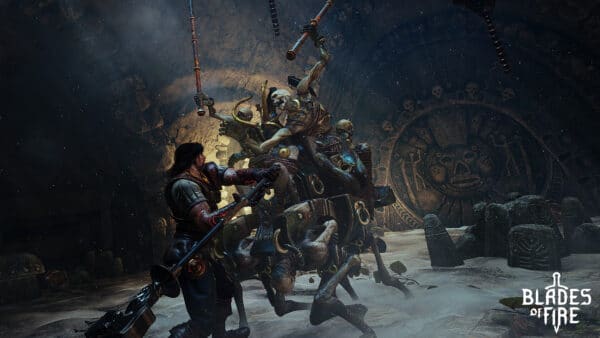
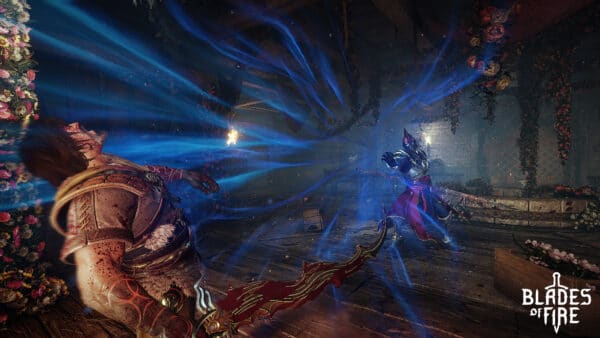
The combat itself is pretty brutal and punishing, though enemies tend to follow a specific pattern that is there for you to learn. But dodging, blocking, and countering are the big things in this game, as well as using the appropriate weapon type and stance against enemies. It’s not the deepest I’ve seen in a game regarding combat, but it is pretty fun once you get the hang of it. There’s definitely a challenge here that can be a little off-putting for some. But death isn’t as harsh as it is in, say, a Souls game, where you lose all your experience and have to retrieve it or risk losing it forever. Instead, when you die, you’ll drop your weapon, and if you die again, it won’t vanish forever. It will remain on the field until you return and pick it up.
The last thing the game really puts a big focus on is exploration. Like the story, you’re just thrown into the world of the game. You get a map, but it’s not very good at telling you where to go or what’s interesting to check out. That is up to you, though there is a set way of progressing through the story. But veering off onto the less-traveled road, players will encounter rare resources, puzzles, and even mini-bosses. In this sense, the world feels more like a Metroidvania-like game when it comes to exploration, with many paths and secrets to uncover. It does eventually lead back to you using the forge to create better weapons to help deal with the challenge, but it’s a fun loop that I liked.
It goes without saying that Blades of Fire is rather unpolished in several areas. I encountered plenty of bugs and odd jank throughout my quest to kill the Queen, and I think a little more time in the oven could have done wonders for the game. But I will say, when it works and plays just right, the combat, the forging system, and the exploration all felt great when it came together. You can see the studio’s passion for this game, which probably kept me returning to it.

Blades of Fire isn’t a game that will redefine the genre or sweep you off your feet with a groundbreaking story. It’s rough around the edges, sporting unpolished visuals and a few too many bugs for comfort. However, beneath that somewhat dated exterior lies a surprising amount of heart and an enjoyable experience. Its “Souls-like” combat, satisfying weapon crafting, and an emphasis on exploration makes for an enjoyable gameplay loop. If you approach Blades of Fire with the understanding that it’s more of a nostalgic callback to the PS2 era—flaws and all—you’ll likely discover a hidden gem. It’s a testament to a studio’s passion, and for those willing to look past its imperfections, a truly fun and challenging adventure awaits.
Score: 7.5/10
Pros
- Old-school PS2-era charm. If you know, you know.
- Fun and challenging combat.
- Forging weapons is one of the coolest ideas the game has to offer.
- Variety of weapons and playstyles for them.
- Fun exploration.
Cons
- Servicable story that you will likely soon forget.
- Unpolished in a lot of areas.
- The in-game map could have been created better. Easy to get lost, which can create a lot of backtracking.
Blades of Fire review code was provided by the publisher. You can read MP1st’s review and scoring policy right here.
Stay connected to MP1st and the latest news by following us on Bluesky, X, Facebook, and TikTok.
This website contains affiliate links. If you click a link and make a purchase, we may earn a commission at no additional cost to you. This helps support our work. Learn more on our affiliate page.