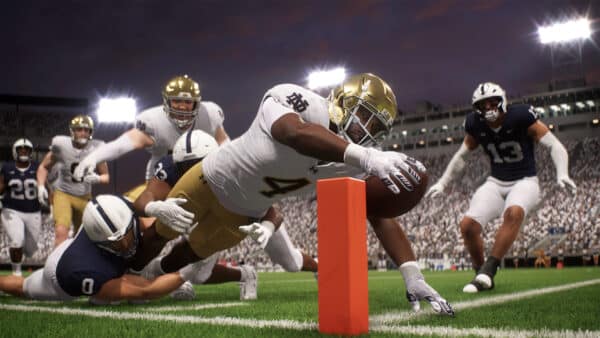
EA Sports College Football 25 Review – It’s Back In the Game

Eleven years may seem like a long time between entries in a game series, but it somehow felt even longer with the NCAA Football franchise due to the annual nature of the genre up to that point. Starting as Bill Walsh College Football in 1993, and eventually changing the name to NCAA Football, the series ran every year for 20 years before essentially being forced to stop due to ongoing litigation over player names, images, and likenesses. After the rules change in college football to allow the players to make NIL deals to make money off of their in-game interpretation in the last few years, EA Sports started working on bringing back the series and it has made its triumphant return with another name change from NCAA Football, to now as EA Sports College Football 25.
A Long Awaited Comeback
Many were worried that College Football 25 would just be a reskin of EA’s Madden football franchise, as that series has become more incremental in its changes (think: copy and paste) in recent years to the disappointment of many. However, EA Sports instead took things in a different direction by starting from scratch and building a college football game at the core. This starts with the presentation first and foremost and extends throughout every nook and cranny of the game.
There is just something special about college football and the gameday experience. As a lifelong diehard University of South Carolina fan through the good and bad years, it’s hard to beat a gameday in-person at your favorite team’s home stadium. EA Sports looked at this idea and used it as a major factor in the design of College Football 25 by making each stadium’s atmosphere and traditions as true to life as possible. This isn’t even to mention the level of detail they spent on the stadiums themselves to make them replicate the real-life versions.
The developers behind the game made a point to get as much detail into each stadium as they could based on information provided to them by each school, which you can tell all the way from stadiums in the SEC down to those in the Sun Belt Conference. This doesn’t mean they are all perfect though, as one thing they messed up with my Gamecocks is the inclusion of fans waving black towels instead of white towels, which is a major part of the South Carolina atmosphere. There have been others that they have already patched since launch, so I’m hopeful little things like this will be fixed over time.

EA Sports College Football 25 also did a great job at getting a number of music tracks, whether it’s bands playing songs for their team or licensed music tracks like “Sandstorm” and Mo Bamba.” On the downside, there are still many missing like South Carolina’s “2001” and Virginia Tech’s “Enter Sandman” which would be great to see added in subsequent entries after they prove it’s worth paying the cost. The menus even have a drumline continually playing to fit the collegiate theme.
Gameday Atmosphere
One major element that the NCAA Football series has always had over Madden is the gameday atmosphere in the game and how much that can impact things, which has returned once again here with Stadium Pulse in College Football 25. Certain stadiums in the game that are known for their tough atmospheres such as LSU’s Death Valley and Michigan’s The Big House are daunting places to play on the road. Not only is it harder to get audibles and changes at the line to accurately happen, but the play call preview on the field is often inaccurate or at least hard to read with the icons when the stadium is rocking. This is also greatly affected by the momentum of the game as well. I remember specifically playing a game against Penn State on the road online against someone and the first few drives were really tough. Once I started to score a few times though, it quieted the crowd down and I had much less trouble except for big third downs. The realism of moments like this really felt impactful and was something that Madden as a series has always lacked.
The very reason that kept the series on hiatus for so long was finally resolved with the introduction of NIL for players, and now that means real life player names are used in the game as long as they opted in before the release of the game. Gone are the randomized names or just numbers of players, even though they were usually based on real-life players regardless, and in are the actual rosters minus any unenrolled freshman at this point. Likely those players will get added through in-season updates, which are expected to happen based on the performance of teams. There is nothing to write home about with the player designs themselves, as they did not do true face scans like they did with Madden, but the players have the names and should match with height, weight, and general stats as well to where it feels like you are actually using them. The one oddity still is that coaches are completely left out of the game still, so you just have random coaches instead of the real ones. I’m sure there is a reason for this, but I’d like to see this change in the future for realism’s sake.
The atmosphere and presentation is top-notch and all, but this game could have been seen as a total failure if the gameplay was just a clone of Madden, especially with how different college and pro ball can be. Thankfully, EA Sports College Football 25 feels like a natural progression from the previous iterations of NCAA Football with the large variety of play types including the more college-focused air raid and option game styles. College always has had a faster tempo and speed to that of the NFL and this game manages to reflect that while also not feeling like a complete overhaul of everything players may be used to in Madden anyways. Little things like having a much more efficient hurry-up system that is often how some college teams play every drive makes a big difference here and I could not be any happier with it.

College Football 25 and Madden Differences
The major change to the gameplay here is the inclusion of a new passing system where there is a meter that ranges from blue, yellow, and red depending on how long you hold down the throw button. By doing this, you will get accurate, less accurate, and even less accurate throws to your target, which reminded me a bit of what you’d see in other sports games like MLB The Show with pitching or NBA 2K with shooting the ball. I have always enjoyed a meter-based system, though it does take getting some used to not trying to hold it down to near the end of the meter for the best throw, as you instead need to release quicker to get the best throw, which is very different from pitching in MLB The Show.
The kicking game also has implemented a similar meter system where you hold it down, but here the goal is to aim and then hold it down to try to get as close to the top without hitting the top of the meter. This has made field goals much less automatic in the game, especially in intense moments online where the game is on the line.
EA Sports College Football 25 has a few different game modes to choose from besides the standard Play Now option. Those who need to get some training in can do so through Mini Games or Open Practice, which is probably smart to get the hang of the new passing mechanics, though you can also just learn on the fly in-game as well.
The often single-player modes in the NCAA series like Dynasty and Road to Glory are always at the forefront compared to Madden where they often feel like an afterthought, so it was nice to see how much the developers spent on making these special and distinct in this returning entry. Dynasty lets you start as either a head coach, offensive coordinator, or defensive coordinator and build your team towards making the College Football Playoffs and winning it all. You can pick any team here, with you able to select your favorite team, a top-tier contender, or even try to take a low-level school to heights never seen by them before, which is what makes this so cool.

For Dynasty mode, I personally have an offline Dynasty going as head coach of the South Carolina Gamecocks as my team, while I also have an ongoing online Dynasty with eight of my friends where we all picked teams with ratings below 80 to try and build them to greatness. This is where all the fun really comes into play, as you not only play the games but also have to recruit against the other schools or even other members of the Dynasty if you are doing one online. Recruiting is a tough process and sometimes doesn’t work out with some players, but the system EA Sports has implemented here is very addicting and adds a lot to the mode between games. The major downside here though is that recruiting in Dynasty mode has had some major bugs since launch, some more annoying than others. EA Sports has been proactive at patching these and says they are continuing to work on fixes, so this is something that shouldn’t be a problem for too long if things work out as planned.
The game’s solely single-player mode is once again known as Road to Glory, where you get to create your own player and play through their entire college career. You can choose between a five-star elite prospect, a four-star blue chip prospect, a three-star contributor prospect, or a two-star underdog prospect. While you may not want to feel like you are cheesing the system by going with a five-star player, this mode is more suited for that if you want to have much playing time. Picking a two-star often means you barely get to play and will have your career over in no time unless you are very lucky.
After selecting a star rating, you get to pick your position between QB, HB, WR, MLB, and CB. From there, each position has three archetype options that provide you with varying stats and physical abilities. You must then design the look of your player, which honestly was very lackluster. The face templates are all way too similar and it felt like they could have offered a lot more options. At least there are a lot more options than for coaches in Dynasty though, where you have very few options to choose from and only two clothing options.
Similar to how Dynasty requires you to do recruiting beyond playing your games, Road to Glory has a lot more for your player to worry about than just the games. Your player has five meters to worry about each and every week, including Academics, Leadership, Health, Training, and Brand. Not increasing or keeping these meters high can cause your player major issues, including ineligibility in the game of academics, downgrades in stats, or a number of other ways. This is even more interesting now with the ability for players to earn money through NIL during the season, as there are dialogue options you get to make that can impact some of these as well. You also have energy points to spend each week that can help increase stats such as Academics or replenish your Health meter if your risk of injury meter has diminished. You also have to worry about Coach Trust each week, with your moments in practice and the weekly game greatly affecting this ranking. By raising Coach Trust, you can move up the depth chart and solidify your position on the team. All of this can seem like a lot beyond the field, but it’s a unique way to keep this game mode fresh throughout your player’s career.
Running to the End Zone
The major fault I found with Road to Glory is the inability to make play calls outside of getting a few change the play call tokens each game as a QB. The play calling AI in this mode is often pretty moronic, such as running the ball on third and long way too often. It would be nice if you could make more changes than you do, but the game wants to be more realistic with the coach calling instead of your player. This often makes you feel like the outcome of the game is entirely out of your hands and will end up losing games where you playing spectacularly regardless.
Road to the CFP is a new game mode in EA Sports College Football 25, but it is essentially the game’s equivalent of ranked online matches against other random players. Rather than just having leaderboards though, the game adds a little wrinkle into the mode by tracking your matches in groups of 10. After 10 games, if you have accumulated enough points to advance to the College Football Playoff, you’ll enter a single elimination bracket akin to the real playoffs and get the chance to win the championship and have it added to your profile on the leaderboard.
What I love about the online ranked system in this game is that it actually rewards you for using lower-tier schools and even allows you to match up against teams in a specific tier. The teams are split into one of three tiers, so you can select a team in Tier 2 and be guaranteed that you will match up with a Tier 2 team if you want. Playing with your favorite team that is not as high ranked is always an issue in games like this usually, but here you can pick your favorite team regardless of the tier and then select to play only teams in that tier so that you don’t have a Coastal Carolina vs. Alabama matchup unless you truly want a challenge.

One of the few really frustrating aspects of EA Sports College Football 25, which may have just been a gameplay choice or oversight, is the inability to select a different playbook online in Road to the CFP or unranked friend matches. The different playbooks at your fingertips, including the ability to create custom ones, is something that is part of the fun in this series and is present throughout the rest of the game. When trying to play online though, you are locked to the specific playbook of the team you have chosen. Outside of online, I much prefer using the Multiple playbook and would love to use it online instead, but the developers for some reason made the choice to disallow this. Hopefully, enough outcry about this will cause them to patch this eventually, as there is really no reason not to allow this here.
The last game mode found in the game is easily my least favorite with EA Sport’s moneymaker, Ultimate Team. This mode has always felt very scummy with the microtransactions in Madden and the now-named FC series, and they are really about the same here as always. The goal is to build a team of players using cards you collect by opening packs, which you have to buy using currency in the game. It is possible to grind and play without spending real money, but unlike MLB The Show’s Diamond Dynasty, you really have to be prepared to invest some real-life money if you want to play this mode. One thing I did like about Ultimate Team in the game though is the usage of former players for colleges that normally you wouldn’t see, with EA Sports likely being able to use them here due to their inclusion in Madden already. There still are a bunch of notable alumni I would like to see, so maybe I’ll check back into this mode once there are more available there to take a trip down memory lane.
Verdict
Finally being able to retire my old copy of NCAA Football 14 for Xbox 360, I was so happy to find that EA Sports College Football 25 was all I wanted and more in its return. There is still room to improve in some areas like with the bugs or additional game modes in the future, but this is a fantastic jumping back on point for the franchise after more than 10 years. For anybody who loved the original series or is just tired of the usual Madden formula, EA Sports College Football 25 may be just the game you’re looking for as it is a love letter to what makes college football so special from the bottom to the top.
Score: 9/10
Pros:
- Captures that real college football feel
- Varying playbook and gameplay options
- Dynasty recruiting system and customization
- Road to Glory’s multi-faceted approach
- Tier-based online matchmaking option
Cons:
- Cannot change playbooks for online play
- Road to Glory play calling AI
EA Sports College Football 25 review code was provided by the publisher. You can read MP1st’s review and scoring policy right here.
This website contains affiliate links. If you click a link and make a purchase, we may earn a commission at no additional cost to you. This helps support our work. Learn more on our affiliate page.