Final Fantasy Tactics: The Ivalice Chronicles Review – Revisiting a Classic

Once nearly ending just as it was getting started, the Final Fantasy franchise is still going strong today with numerous mainline entries and spin-offs over the years. While it was not the first spin-off, one of the most well-regarded in the series has always been Final Fantasy Tactics on the original PlayStation, which was released back in 1997.
This game not only garnered a few semi-sequels of its own on the Game Boy Advance, but also received an enhanced port on the PSP as Final Fantasy Tactics: War of the Lions in 2007, a decade after the original released.
Now, 18 years later, one of the best entries in the entire series is getting new life on modern platforms with the release of Final Fantasy Tactics: The Ivalice Chronicles, which is more than a visual upgrade.
Choose Your Version
Like many remakes and remasters, Final Fantasy Tactics: The Ivalice Chronicles offers players the opportunity to choose whether to play the game with the Classic version of the game that has the PS1 visuals and the English translation from the War of the Lions release, or play the updated The Ivalice Chronicles version that has been created just for this release.
This choice must be made from the main menu of the game, where you have to choose which one you want immediately. There are no cross-saves between the two, unfortunately, making you have to start the game entirely over if you want to switch visual styles. I was hoping to see a way to switch art styles like we’ve seen in a number of remakes over time, but that is not available here at all due to some new features in the modern version.
Considering Final Fantasy Tactics is older and a lot of people likely have not gotten the opportunity to play it in the past, we’ll start by going over the game itself and then break down the new features and such that set apart The Ivalice Chronicles and Classic versions within this package.
Final Fantasy Tactics is a turn-based tactical RPG, similar to other franchises like Fire Emblem, Ogre Battle, and Disgaea. However, Final Fantasy Tactics is often cited as the tactical RPG that really made an impact in the Western world. This is likely largely due to the Final Fantasy name that was just coming off the major success and hype of Final Fantasy VII, while also maintaining the high level of storytelling that has been a key to making the franchise so popular over the years.
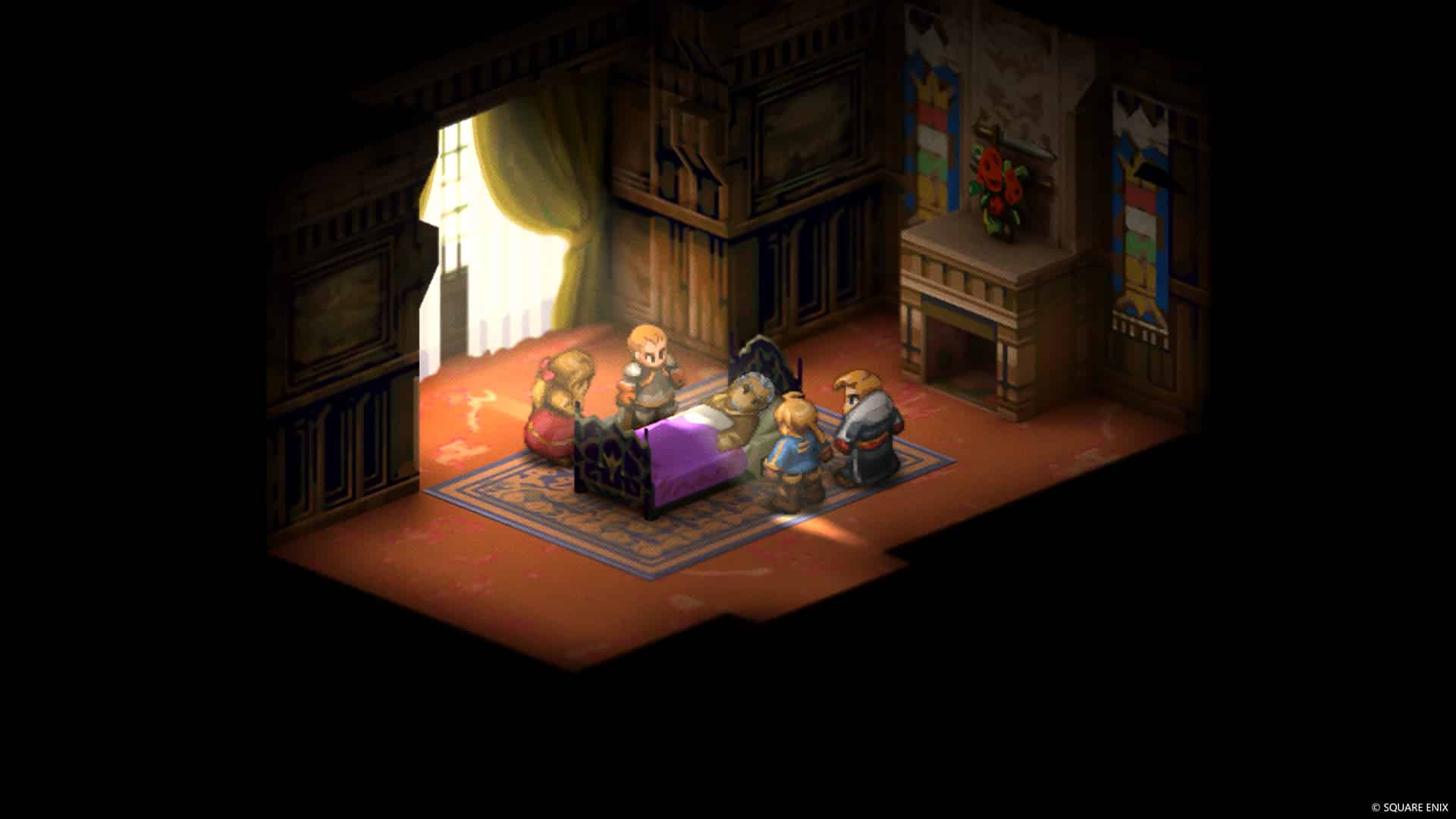
The world of Ivalice is the setting for Final Fantasy Tactics, which anybody who has played Final Fantasy XII should recognize as the same world. Following Final Fantasy VII and the subsequent Final Fantasy VIII, which featured a more modern setting, Final Fantasy Tactics had a setting inspired by the Middle Ages, returning to the true world of fantasy that the series began with. This game begins as the Fifty Years’ War has just ended, but a new war is now forming over who should lead Ivalice in the aftermath. The Black Lion Prince Goltana and White Lion Prince Larg are vying for the throne, which leads to the actual War of the Lions as a result.
Ramza serves as the main player character in Final Fantasy Tactics, who is a noble born of the Beoulve family, and is dragged into all of this mess. Much of the story becomes a case of who is really in the right, as the noblemen feel they are always in the right, while you have other parties like the Corpse Brigade that many commoners join to try and fight back against the idea of tyrannical rulers. As someone who has played numerous Final Fantasy games over the years and had not previously played through Tactics, I was absolutely captivated by the story from very early on and couldn’t stop playing. There are twists and deaths that you never see coming, which is why you should play without reading any more into the story than what I have provided so that you can truly enjoy it for the first time.
The structure found within Final Fantasy Tactics is that you have story segments, then you can move between locations on a world map, where you just move point to point. The next story segments are marked with a specific icon, while other locations are also worth visiting for a few reasons. When you usually first visit a new town, castle, or main point of interest, there will usually be a battle here that you have to complete, with in-between spots on the map serving as where you can go to grind for additional battles, sometimes with them actually having random encounters as you walk past them on the map.
A Grid-Based Battle
Final Fantasy Tactics’ battle system is unlike anything else in the series outside of the other Tactics entries, which is actually a good thing. To start, you must select a group of characters from your overall party to use in battle by placing them on the grid, with the number allowed varying depending on whether there are guest characters filling up spots. As a rule, you’ll be able to place five of them though. You not only get to pick who you use, but also where within the small starting area of the map. This is where you want to already be strategizing on which jobs to place in front and which to place in the back. From there, it’s time to battle.
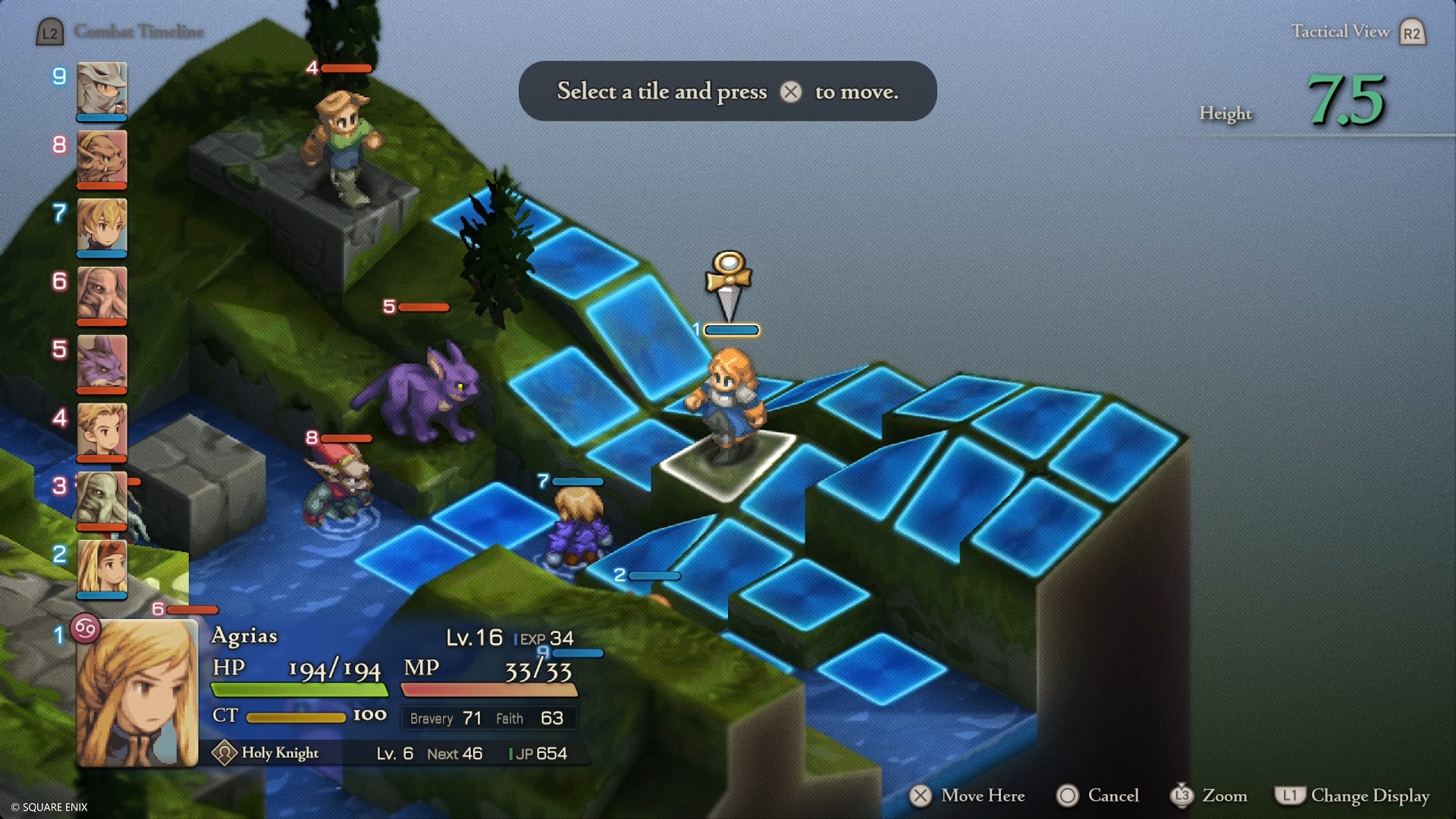
As seen in the new The Ivalice Chronicles version, a bar on the left side of the screen is always visible, listing all the characters in the battle on both sides and indicating the order in which they will take their next move. This is also signified by the number above their head at all times that will change as each one goes and they move down the list. When it is one of your characters’ turns, you can choose to do a few things. Typically, each turn consists of a movement phase and an action phase. If you are out of range and do not have any attacks or abilities that can be used, you may just have to use the wait command instead. As far as moving, your character’s movement range depends on their job, level, and abilities, which could also affect the range.
Once you select the move option, you can see how far they can move by selecting one of the open blue squares. This honestly did get quite annoying at times, as the icon did not always move in the way you wanted it to. Now, the movement of the cursor can be in eight directions, including diagonally, instead of just in four directions like in the past. You often also have to move the map itself around to see behind obstacles, so this can take some getting used to over time. You can go ahead and set your move and take it back if you didn’t end up being in range of attack or something too.
The other phase, which occurs each turn, involves performing an action that can be done before or after the move phase. The typical action here is to directly attack the enemy by moving close to them and choosing to engage in combat. However, each job has an array of different abilities that you can use, such as Black Mage’s Black Magick attacks, the Thief’s steal abilities, or something as simple as the Squire’s throw rock attack. This is where the game’s job system really comes into play.
Final Fantasy Tactics features 20 different job classes to choose from, with starting options like Squire and Chemist before getting to move on to stronger classes like Monk, Time Mage, and Samurai. The way the game works is that characters are assigned a class to start with, but can switch to any of the other base-level ones if they want. From there, they need to level up existing classes to then be able to unlock higher-level ones. For instance, to unlock either Black Mage or White Mage, you had to start as a Chemist and raise it’s level to 2, where you could then swap to the new class. If you move to the Black Mage job, you can then level it up to access the Time Mage class and so on. In addition, characters earn JP, or Job Points, for the various classes even if they aren’t that class at the time. With the earned JP in each class, you can then go and unlock abilities related to that class to use if you are using that job or also in another interesting way.

Each character not only has a main job that they have selected, but they also have an abilities menu that you can customize. Beyond the main class, you have four other slots to fill, made up of Action Abilities, Reaction Abilities, Support Abilities, and Movement Abilities. The Action Abilities are probably the most important here, as you can equip things like Items or even Black or White Magick on a Squire to use in battle, allowing you to cover more bases on the battlefield with the limited number of characters that you have at one time. Reaction Abilities are related to what happens in battle, such as having Counter Tackle to respond when attacked with a counterattack sometimes. Support Abilities include boosts to the amount of JP earned with JP Boost or the ability to equip axes, so they can be helpful too. Movement Abilities can also be a big help, as you can make your units more mobile in battle with specific movement upgrades.
When it comes to the towns, you can visit the Outfitter to buy and sell various goods. Upgrading your weapons and armor is always a good idea here, as well as picking up some useful items that you may need. The Tavern is also available here, where you can read rumors to learn much more lore about the backstory of the game than you would be told otherwise. Errands will also become available here in the Tavern starting in Chapter 2, which allow you to send characters off to complete errands to bring back JP and gil. This is extremely helpful to level up jobs that may be harder to continually earn JP for in battle, such as White Mage.
You also have the Warriors’ Guild available to you, where you can recruit new allies to use in battle. The location of the Warriors’ Guild will differ depending on the available warriors that you can recruit, which will cost you some gil to acquire. You can also rename existing team members from here.
Easily one of the most controversial aspects of Final Fantasy Tactics since day one has been the permadeath feature. Many games like Fire Emblem often allow you to turn off permadeath so that you don’t have to worry about losing important team members in a battle forever, but Final Fantasy Tactics and now Final Fantasy Tactics: The Ivalice Chronicles do not include a way to turn it off. Whenever a character dies in battle, they will have three hearts appear above their dead body and you will have that many turns to save them or they will turn into a crystal and be gone forever. This adds a lot more urgency and intensity to battles, knowing that you cannot use any of your party members as a sacrificial lamb at any point or try to pull out a last-second victory while most of your party is dead. On the plus side, this new version of the game does make this process a little easier, which is only the start of the quality-of-life inclusions added.

Quality of Life Improvements
One of the most important new quality of life features is the easy method of running from a battle at any time, with the option to just respawn on the world map as if you hadn’t started the battle yet or just restart the battle with a redone character lineup or even the same one with a fresh start. This means you can immediately exit a battle when someone dies, or perhaps you saw that your strategy wasn’t working and would rather start from scratch to try again, instead of wasting the time to keep going through it.
Perhaps even more helpful is the game’s new speed-up feature, which has become a signature staple of modern releases of classic Final Fantasy games. By holding down R1, the battles and conversations will speed up, making the long enemy turns much more tolerable than in the past. I do wish there was a way to just have the game run at a faster speed like other re-releases of Final Fantasy games, but this at least makes things so much faster and enjoyable over the many, many hours of the game, especially when you’re dying to find out what is going to happen next in the compelling story.
Another fantastic addition is that of full voice acting throughout the game. Often, games Final Fantasy Tactics get minimal voice acting due to the large amount of dialogue, but Square Enix went the extra mile in Final Fantasy Tactics: The Ivalice Chronicles by adding voiced lines to nearly everything. This added a lot to the already emotional story, especially with some key moments handled very well. Also, how can you have a game now without Ben Starr voicing someone in it?
When it comes to cutscenes in Final Fantasy Tactics: The Ivalice Chronicles, the development team decided to eschew the now dated cutscene style from the original game and has instead replaced it with animated cutscenes that have an almost watercolor painting style to them. These scenes are beautifully animated and are visible from the beginning of the game, starting with the opening sequence. I thought this was a very unique way to modernize the cutscenes here, without making them feel too out of place alongside the now-updated sprite graphics.

The visuals in this new version of the game aren’t too far removed from the original, but have now received a resolution and quality boost to make the character sprites and backgrounds look better. This is something that may be controversial to some, but I actually thought looked quite good in action. There are some that wanted a 2.5D look akin to Octopath Traveler and the recent Dragon Quest III remake. However, I believe the route they chose to go looks great while playing and was a wise decision.
While saying that, I actually still quite enjoy the original visuals found in the Classic version too. They are just as you remember them on the PS1 version, with the animated sprites on the 3D plane. The sprites may not be as perfect looking at the new version either, but they once again really capture that era of games where the sprites had evolved past what we had in Final Fantasy VI, yet weren’t trying to go for the blocky style found in Final Fantasy VII. This was a nice in-between that I think still holds up very well and is why The Ivalice Chronicles version in the game really didn’t change the design all that much except to make it look smoother and more polished alongside the upgraded backgrounds.
The game’s UI has been significantly improved compared to the original in several ways, as it is now much more intuitive. Unlike in the original, each of the menu options is laid out so that it tells you what they do at any given time, rather than having to wait and find out in the pause menu later. An example of this is with basic abilities like Salve or Tailwind, which you likely would not know what they do at all until you use them otherwise. This version immediately tells you what these abilities do when you hover over them though, making things so much more accessible. In comparison, the UI in the Classic version still looks good, but is definitely lacking. When you hover over an ability like Salve, it doesn’t tell you anything and you just have to guess until you look more closely outside of battle. You should always know what you have at your disposal in battle before entering, but it’s still great to have the ability to see what is going on within battle beforehand too.
The Classic version maintains everything from the original release, except for the updated English translation from War of the Lions as mentioned prior, which can be seen as a good or bad thing for some. The visuals are definitely of that PS1 era where they were attempting to create cutscenes with the capabilities that they had. I actually have a soft spot for these from other games like Final Fantasy VII, VIII, and IX, which felt very similar here in the opening cutscene. As aforementioned, The Ivalice Chronicles version of the game instead decided to go away from the realistic cutscene look in the opening and instead went with the watercolor painting-like animated opening. They both have their perks, but I cannot say that I almost don’t love the original version better just for nostalgia sake in the opening.

If you choose to play the Classic style version, there is still a major quality of life addition in the form of auto-save. Classic version adds an auto-save feature that was not in the original at all, so this at least helps you in the case of not saving before a big fight where you lose key party members or something. A major downside, though, is that the speed-up feature found in The Ivalice Chronicles version has not been added to the Classic version. This means you will be sitting around much longer between battles instead of being able to fast forward through the slow moments.
While the new additions and all of the content included is plenty, it is disappointing that the developers chose to leave out the extra content added in the War of the Lions version outside of the English translation. That version added new characters, jobs, and even cutscenes that will not be in this version at all. I can understand leaving out the multiplayer content from the game, but the other content would have been a nice little addition for completionists that may not feel this is not the end all be all version as a result. There is also no new content just for this version like you often see in some remakes too, so that was a little bit of a letdown.
Verdict
Final Fantasy Tactics was already a stellar game with one of the best and most riveting stories in the entire franchise, even underrated a bit perhaps due to the genre for mainstream audiences at the time of original release, and now players are getting a chance to play it again with some major quality of life changes to make the experience better. For traditionalists, you can still play the Classic version of the game that you grew up with, minus the dialogue changes from the PSP release, while others can play the new The Ivalice Chronicles version. Featuring a much-improved UI, the ability to speed up battles, full voice acting, and more, you really can’t go wrong with this release. Even with the missing War of the Lions content and no new actual content added, it’s hard to argue against Final Fantasy Tactics: The Ivalice Chronicles now being the definitive edition of Final Fantasy Tactics with all of the upgrades included that have improved the overall game experience, while also still having the original to always go back to as well.
Score: 9/10

Pros:
- Still one of the best stories in the series
- Well designed job system
- Addition of full voice acting
- Quality of life additions
- Includes new version and the Classic version
Cons:
- Missing War of Lions extra content
- No new content added
- Permadeath may still turn some people off
Final Fantasy Tactics: The Ivalice Chronicles was provided by the publisher. You can read MP1st’s review and scoring policy right here.
This website contains affiliate links. If you click a link and make a purchase, we may earn a commission at no additional cost to you. This helps support our work. Learn more on our affiliate page.