Metaphor: ReFantazio Review – Political Fantasy

Atlus is known as one of the most prolific and critically acclaimed developers over the last many years, with a large number of their more recent games being RPGs of some sort. More specifically, the Persona and Shin Megami Tensei series have been a major part of their success, but their latest game is a completely original game, albeit with some familiar elements, known as Metaphor: ReFantazio.
Does it deliver the same quality of quirkiness and gameplay? To say yes would be an understatement, as Metaphor: ReFantazio manages to be a great game that surpasses the franchises it’s being compared to.
Take the Throne
Metaphor: ReFantazio takes place in the United Kingdom of Euchronia and begins with the king’s assassination. For years, the kingdom has thought the prince was already dead as well, but in actuality, he was cursed and has been in hiding ever since. With the king killed in secret, his actual killer named Louis Guiabern tries to take the throne by force. However, this brings forth the spirit of the king who protects the throne through magic and requires the new king to be named through a tournament where making allies and gaining followers is the most important element.
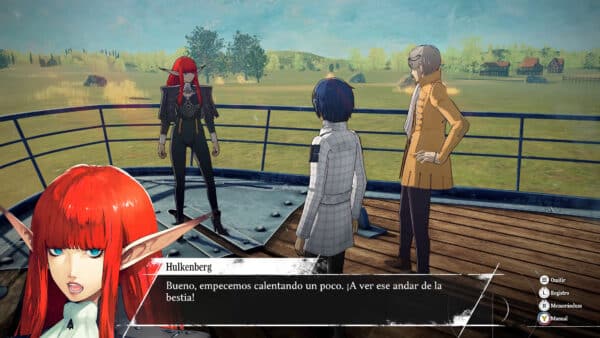
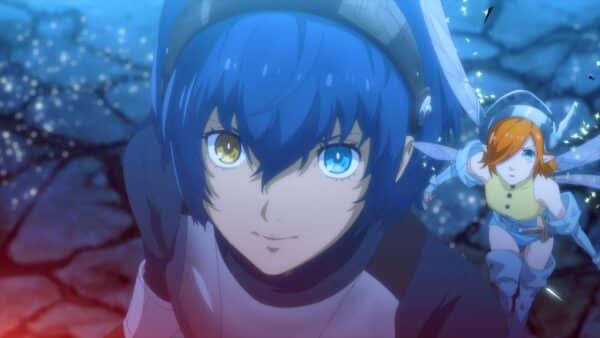
The unnamed main protagonist is a close friend of the thought-dead prince and is sent on a mission alongside his fairy companion Gallica to try to find a way to break the curse afflicting the prince. Very quickly, the protagonist runs into a noble named Strohl, followed by other party members, such as Grius and Hulkenberg to just name a few early ones to avoid any major spoilers.

There is something very special about the protagonist in the game, as he is able to unlock what are known as Archetypes in the game that are much more powerful forms that you can use in combat. This happens very naturally in the story the first time and then is handled incredibly well with subsequent characters that gain this ability through the connection drawn between the protagonist and the respective party members.
There are plenty of captivating RPG narratives out there, but Metaphor: ReFantazio manages to stand amongst the best in the genre. Introducing the different tribes into the mix, such as the protagonist’s elda tribe heritage that is often discriminated against across Euchronia. Loyalty plays a large role in the game as well, which I really thought tied into not just the different characters in your party, but also gaining trust with the masses when trying to build towards taking the throne in competition with others. I was also immediately intrigued by how the main monsters in the games were known as “Humans” and how that would continue to play into things as the game moved on considering the majority of the world’s character look like what we would define as human, rather than these monstrous creatures that the game calls human. The story is easily one of the best I’ve played in recent years and is well worth experiencing mostly blind besides what I’ve mentioned when playing for the first time.
Night & Day
Anyone that has played a Persona game before will recognize a similar system in Metaphor: ReFantazio with its time-based system. There are segments of the game where you have limited time to complete a task, with you receiving a game over if you do not complete it by the final day. These days are split into two parts, day and night. Daytime is the only time you can explore the dungeons found throughout the game and must rest that night. If you do not take on a dungeon during the day, you can use the night to explore the town further. Having a restrictive time-based system can be a turn-off for some players, while it can also add layers of strategy into the game than would not be there otherwise as a result.

As just mentioned, Metaphor: ReFantazio has plenty of dungeons for you to crawl through in familiar fashion. Within these dungeons, the goal is to make it to the end, but there are plenty of enemies that want to prevent you from being able to do so. When you come across an enemy in a dungeon, you have a few options at your disposal. Depending on the level of the enemies, you can either defeat them in the overworld itself or take it to a turn-based battle system if they are too strong to handle the easy way. For the first option, you can just press X rapidly in the overworld to attack the enemy and take them out without much trouble, which helps to prevent combat from becoming a slog like some RPGs can suffer from with constant turn-based battles. The good news is that there is an easy way to tell just who you can attack the easy way or if you will have to go the other route.
By using Gallica’s Fae Sight ability by pressing the left trigger, you can see what Gallica senses in the environment, including any surrounding enemies. Each enemy will register in different colors when using Fae Sight to give you a heads-up. Lower-level enemies will glow blue, similar-level enemies to you will glow yellow, and higher-level enemies will glow red. Unknown enemies that you haven’t come across before will appear white though, so you have to be extra careful with them. For enemies that are not defeated so easily, you can either attack them to start a normal battle or start with a Squad Battle instead by pressing the corresponding button.
This enters the main combat sequences, which are turn-based between your party members and the enemies you are facing. Depending on the speed of your characters and the enemies, there may be different numbers of attacks per turn, which can get really dicey when the enemy starts attacking two or even three times in one go. Like many games such as this though, you can get an advantage on the opposition by ambushing them in the overworld rather than letting them touch you first and making your party vulnerable to start.

The combat system in Metaphor: ReFantazio is centered around the previously mentioned Archetypes, which serve as the game’s class system essentially. The game’s variation of a skill tree is known as the Archetype Tree, which is done through Akademeia after you visit there in the game. A character named More is introduced in Akademeia, as he is trapped there and is essentially in purgatory. Archetypes in this game are a version of classes like you’d see in many traditional RPGs, such as Warrior, Mage, and Thief. There are 14 total of these base Archetypes, but they can then branch out further to more advanced versions of each Archetype, such as Samurai, Warlock, and Assassin. The 14 Archetypes have differing numbers of advanced options, so you may want to look into this online before diving too much into any of them in the game. Each party member in the game can study the Archetypes that you get throughout the story by expending MAG that you earn in battle. Once a character has learned an Archetype, you can change their current one without having to spend anymore MAG thankfully.
Every character has their basic attack they can use to varying degrees or damage depending on what their archetype is and the equipment they have. More important are the skills that you have available depending on your currently equipped Archetype, such as Seeker giving you wind-based spells or Mage giving you a mix of fire, ice, and electric-based spells. Very importantly, you can also set a skill or two that you’ve unlocked under a different Archetype with that character through Skill Inheritance by spending MAG for the first time you do so. This allows you to say give your Mage healing skills that they would not otherwise have access to. The versatility here with being able to switch Archetypes and mix and match skills is stellar and makes the combat system feel so robust and exciting to play around with.
A little further into the game, you will unlock what are known as Synthesis skills, which are cooperative moves depending on your party’s Archetypes. Paired Archetypes can work together by selecting these Synthesis skills in battle, but at the expense of using up both character’s turns. These sort of reminded me of the Synergy attacks in Final Fantasy VII Rebirth, though the timing with using them was sometimes a little more confusing.

Party members can also be afflicted with various status effects in battle, including things like Burn and even Anxiety. The latter comes when you are ambushed into battle or get a critical hit from an enemy during battle. When afflicted by anxiety, you cannot control Archetype skills and enemy attacks don’t even count on the turn gauge, which can get really dangerous quickly if you’re not careful.
The combat system in Metaphor: ReFantazio has a lot of elements to it that you must learn to fully master it. Something that really helps with getting to learn this though is a feature that is pretty rare for RPGs, which is the ability to restart any battle if you feel like it is not going the way it should be. By pressing L3 at anytime during combat, you can restart the encounter entirely. This allows you to try different strategies if you are failing to defeat an enemy, which is a great and very unique feature to include.
Test Your Might!
The dungeons in the game vary in size, though they are rarely massive to where you would get lost. Thankfully, you will start to build a map of the dungeon’s layout as you explore, so it’s wise to try and check every nook and cranny. However, that can sometimes be a little more difficult as you start to fun out of HP, MP, and supplies. You also don’t want to die too suddenly and lose a lot of progress, but that is where the magla hollows come into play.

Making your way through a dungeon can really test your might, but thankfully there are areas known as magla hollows that serve as safe havens for your party. Visiting magla hallows will allow you to save your game, talk to allies, and go to Akademeia to speak with Mor. As you unlock more magla hallows within dungeons, you can even transport between them within that one dungeon if need be. However, the one thing it will not do is allow your party to actually rest and heal without using up items that you have. This may seem like unfortunate game design, but it’s really a design choice to make things more difficult here. It may be frustrating for those hoping to save their inventory of items for other times, but at least it allows you to do the other things along the way, most important with saving.
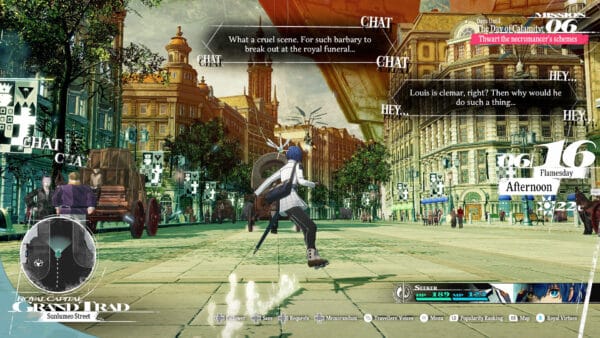
Outside of the dungeons, you will be taking on a variety of quests in the points of the calendar where you are given free reign to make your own decisions on how you want to do things. When traversing the cities, you can utilize a technique known as blade-riding. This allows you to hop on your sword and ride around the city, even being able to increase the speed. This allows you to traverse the cities at a much faster pace, which is a great tool to have.
A large majority of the quests and sidequests you’ll come across in the game will tie into what is known as the Royal Virtues system that plays a major role in the game with your main character. Your character is measured by five different Royal Virtues that you must work to increase throughout the game, including Courage, Wisdom, Tolerance, Eloquence, and Imagination. By improving your ranks on these virtues, you can better help some followers in the game and even improve the relationships with them. Choosing which of these to increase if up to you with how you can repeat certain actions to improve ones with your limited time restraints.

The visuals found in Metaphor: ReFantazio are pretty solid throughout, showing off the very interesting character designs well most of the time. The environments aren’t always the most fleshed out it doesn’t feel like, but they get the job done enough when it matters. The performance was also really smooth when playing on Xbox Series X, with no issues with framerate drops that were very noticeable.
A standout feature of the game is without question the soundtrack, which has established a bit of a cult following since launch and for good reason. The very memorable battle theme is an earworm that you will keep jamming out to every time you hear it, mixed with a very enjoyable collection of other tracks throughout. One downside on the game is that it really could have used more voice acting though, especially with how good what is included already is in the game.
Verdict
Metaphor: ReFantazio is a great example of a game that was completely off of my radar until I had the opportunity to play it and fell in love with it. The deep combat system offers players a lot of customization with how they want to outfit their team and take on the often quite difficult dungeons, though the time-based restrictions may keep some people from ever giving the game a chance unfortunately. With a story that is up there with the best that the genre has to offer, Metaphor: ReFantazio is easily one of the best games of 2024 that should not be overlooked.
Score: 9.5/10

Pros:
- Amazing narrative
- Deep combat system
- Archetype switching is so easy
- Well-designed dungeons
- Intriguing characters
Cons:
- Time-restrictions may turn off some gamers
- Could have used more voice acting
Metaphor: ReFantazio Remake was provided by the publisher. You can read MP1st’s review and scoring policy right here.
This website contains affiliate links. If you click a link and make a purchase, we may earn a commission at no additional cost to you. This helps support our work. Learn more on our affiliate page.