Nobody Wants to Die Review – Futuristic Detective Work

Have you ever wanted to be a detective? Or maybe you watched Minority Report and wanted to experience the same thing? While Nobody Wants to Die can’t turn you into Tom Cruise, it can do the next best thing and let you relive your sci-fi detective fantasies and all in stunning visuals.
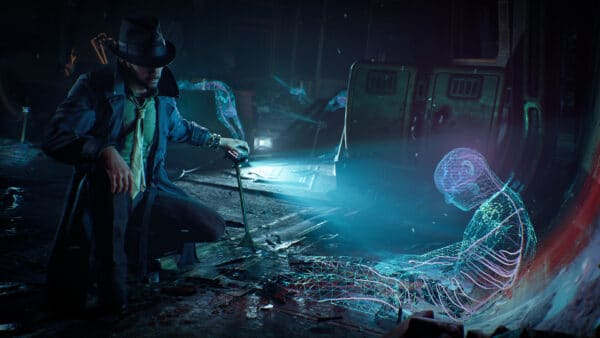
The Unreal Engine 5 powers this experience, and it looks fantastic. The art style will draw obvious comparisons to BioShock, Fallout, and even Cyberpunk 2077, and for good reason. Those are also all great-looking games featuring a futuristic or retro-futuristic style to them. Environments look crisp, character models are detailed, visual effects pop. Visually, Nobody Wants to Die certainly impresses.
Looks to Kill For
Perhaps part of the reason the game is able to look so good is because there aren’t the sort of traditional systems that constantly run in the background in other more traditional games. Since this is a detective game at its core, there are no enemies to shoot, no driving around outside of scripted moments, and no real (time) action to speak of. So, presumably, the assets on display are easily rendered in higher fidelity than would otherwise be possible.
Nobody Wants to Die is also well-voiced. Protagonist Detective James Karra is a hard-drinking, damaged man who is haunted by his recent past, where he was involved in a major train crash, as well as his more distant past, in the form of his deceased wife. His handler Sara is a dryly sarcastic member of the force, who typically plays by the rules, but even Karra’s unorthodox methods eventually rub off on her. The police chief feels like a necessary evil, one who mostly follows the rules, but also understands that the rules don’t usually apply to the rich. Having said that, he doesn’t keep too tight of a leash on Karra, thus the player is free to explore crime scenes at their leisure.
The world of Nobody Wants to Die is dripping in gritty noir style. Picture Times Square circa 1950, but throw in a ton of futuristic or sci-fi tech ala Fallout or BioShock, and you’ve got a pretty good idea of the aesthetic chosen here. In this view of the world in the year 2329, immortality has effectively been achieved for humankind within the past century or so. A material called ichorite has been embedded in everyone’s brain. This unobtainium-class material can seamlessly transfer your consciousness from one body to the next. Naturally, such a thing comes with a price. If you can’t pay for a new body, you are stored in a memory bank, presumably to be reawakened at a later date when a cheap enough body comes around. For the most part, dying is seen as a temporary setback for most people. There are various paper posters around the city that encourage people to take care of their bodies, such as getting at least 10,000 steps in a day. In fact, because your new body is often on loan, it is a legal requirement that you maintain it. This aspect of living forever, and remaining forever in debt, is not really touched upon as much in the story as it could have been, but then I suppose it could be reasoned that Detective Karra is too busy trying to solve an actual, old-fashioned murder (where ichorite has been destroyed, thus ensuring a transfer of consciousness cannot take place), and struggling through his own trauma and demons, to really sit and pontificate on the finer points of living forever.

Simple Gameplay, Intricate Details
For each new crime scene you encounter, you’ll use a couple of futuristic tools to piece things together. The main tool, a Reconstructor, lets you rewind time to show you the events leading up to what you walked in on – usually a murder scene. You are tasked with finding objects or events to interact with, and occasionally using a UV light which Karra is afraid of (though he insists it’s just the rays he’s afraid of), along with a handheld X-ray device to solve puzzles. As characters talk to Karra, there’s usually at least one branching dialogue or action choice to make, with some extra choices unlocked depending upon how you’ve reacted in previous scenarios. I was kind of reminded of Everybody’s Gone to the Rapture, where everything has already happened by the time you arrive on the scene, and you’re simply here to figure out what caused such a tragedy. Though unlike that game, here you can interact with and have an effect on things around you.
Some people may call this game a walking simulator. It’s true, you mostly walk, explore an area, uncover all clues, piece those clues together on an interactive board, and then move on to the next chapter to rinse and repeat. While it won’t be for everyone, and can feel repetitive at times, the setting and story should keep most players entertained throughout. There are also multiple endings, and many branching dialogue paths that offer up some replayability. At a launch price of $24.99 ($22.49 for PS Plus members), this roughly six-hour adventure feels like it’s worth the lower cost.
Nobody Wants to Die is a fun time, if you like piecing together a whodunnit. Outside of that, though, don’t expect anything more. The story is thoroughly entertaining, and at least two endings paired with branching story beats ensures you’ll see or hear something different if you play it more than once. While a low-action, linear game probably isn’t everyone’s cup of tea, those who like this style will find plenty to love in Nobody Wants to Die. Critical Hit Games has done a great job for their debut title, and hopefully we will see more from them in the future.
Score: 8.5/10
Pros:
- Looks and sounds great
- Very entertaining story
- Doesn’t overstay its welcome at around six hours
Cons:
- Can get repetitive
- Some may call it a “walking simulator”
Nobody Wants to Die review code was provided by the publisher. You can read MP1st’s review and scoring policy right here.
This website contains affiliate links. If you click a link and make a purchase, we may earn a commission at no additional cost to you. This helps support our work. Learn more on our affiliate page.