Turtle Beach Stealth 600 Gen 3 Review – More Cost for a Lot Better Sound

Turtle Beach has unleashed two brand-new headphones, the Stealth 500 and Atlas Air. However, Stealth 600 fans weren’t left out in the cold, as the latest Gen 3 model has arrived. We spent some time putting this latest iteration through its paces, and have our Turtle Beach Stealth 600 review ready below.
Third Time’s A Charm
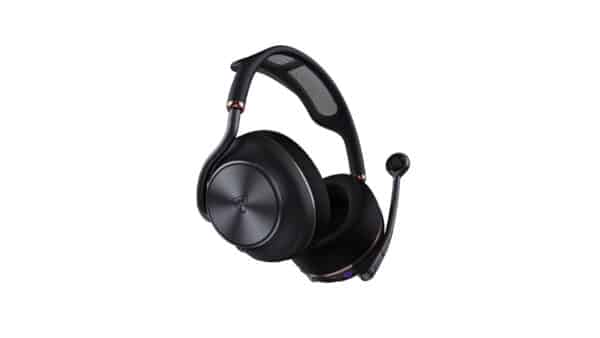
The Stealth 600 series of wireless headphones have been around since 2018. What started as a creaky plastic-heavy affair has turned into a solid performer that enough people have liked to warrant not just one, but now two follow-up products. This third version is decidedly more low-profile in appearance than the Gen 2 model, and is available in white or black (we opted for black). For the black model, a dark, matte black plastic is used throughout, with TURTLE BEACH lining both earcups. There’s no real telling which version you have, as the PC, PS, and Xbox units no longer sport obvious colorways. Some may like this departure, while others will not. The earcups can be folded flat, at least, for easier portability.
In the box, you’ll find the headphones, the USB-A transmitter for use with PC, PS, Xbox, or Switch platforms depending on model, a 2.3ft/0.7m-long USB-A to USB-C charging cable (the PC version gets a longer 6.6ft/2m cord, along with exclusive Waves 3D audio effects), and a quick start guide. All of this is within a form-fitted inner cardboard packaging. Pretty barebones, but I’d rather see that my money went towards the hardware as opposed to fancy packaging, at least at this price point.
Are these largely the same as the previous generation of the Stealth 600? Well, yes and no. While the driver size remains the same, they use Nanoclear, which is some sort of audio technology that Turtle Beach doesn’t really expand upon much in its press materials. Two of the biggest changes, though, are the inclusion of Bluetooth and a larger battery to help achieve a truly stellar battery life (more on that later). All controls are located on the left earcup, including two different volume wheels, which have a slightly different texture so that you can tell them apart by feel alone, a nice touch. The headphones are comfortable to wear during long gaming sessions, though the clamping force can be a little tiring after several hours. This may not always be the case, though, as headphones can get a little looser with repeated use. Unlike the Atlas Air or even the cheaper Stealth 500, the Stealth 600 does not have a floating inner headband incorporated in its design. This has never been the case with the Stealth 600 line, though, so that seems to be the reason for its absence here, done so in the name of tradition. Personally, I prefer the floating headband style as I find them more comfortable and easier to use than headphones where you have to adjust the position of each earcup, but this is mostly a subjective feeling.

Stamina for Weeks
What about the competition? There are some serious heavy hitter hovering around the $100 price point, as you’re at the cusp of mid-level consumer-grade headphones. Gaming brand Razer comes to mind, with their Kaira headphones. Priced the same as the Stealth 600, they have 50mm drivers as well. Wireless and Bluetooth are available, and it generally seems like a decent competitor, however, the battery life is only rated for 30 hours, less than half of the Stealth 600. For some, that’s a deal breaker, and indeed even Microsoft, SteelSeries, and Plantronics-branded headsets in this price range all fall short of the Stealth 600 when it comes to battery life. Most headsets around this price also use smaller 40mm drivers, so whatever Turtle Beach did to cram their drivers in alongside a large enough battery to power the experience was worth it.
Setup is much the same as Turtle Beach’s other models, where they default to wireless transmission, and must be switched into Bluetooth mode via the Quick Connect button before pairing with other devices can take place. It’s slightly unintuitive, but once you’ve become used to Turtle Beach’s way of doing things, it’s easy to remember. It should be noted that the USB transmitter offers impeccable signal range. Much like with the Stealth 500s, I found myself free to roam around my entire house (a two-story, roughly 2000 sqft house built in the ‘60s) without ANY loss in signal. I had to start walking down our driveway before the audio started to drop. Rest assured, a trip to the kitchen for some snacks will not interrupt your tunes or your gaming audio.
A large transmission range is great and all, but it’s kind of a moot point if the headphones don’t sound any good. Happily, I can report that the Stealth 600s sound much better than the 500s. Again, not that the 500s sounded particularly bad, just that they offered no real oomph to the audio like what the 600s bring to the table. Turtle Beach’s 50mm Nanoclear dynamic transducers offer the same standard 20 Hz – 20kHz frequency response range, however perhaps owing to their larger diameter, they are capable of delivering a more detailed, powerful sound signature. The default “Signature” EQ preset it fairly flat, but even then a much more pronounced bass can quickly be felt. With an MSRP of $99, it’s incredible to hear just how much better things can be for a mere $20 more.

Same App, Same Flip-to-Mute Mic, Outstanding Battery Life
As these are closed-back, over-ear headphones, the Stealth 600 offers some natural sound isolation. Though, without active noise cancelling, you’ll still hear a lot of your surroundings until you crank up the volume a bit. Even then, you’ll probably still hear loud noises like vacuum cleaners or city noise from time to time. Good noise cancelling is still a premium feature, so it’s not surprising to not see it here. The flip-to-mute microphone is reliable, and it’s satisfying to click into place. There is an AI-based noise reduction feature toggleable on the mic, which seems to work fine as those I spoke to said I sounded clear.
The same newly-released Swarm II application can be used with the Stealth 600, on the same platforms as before: Windows, Android, and iOS. Using any version will allow you to update firmware, mess with settings, and change EQ presets, among other features, including modifying what one of the volume wheels and mode button does. The application runs a bit more smoothly on my phone than my laptop, though as my phone (a 2022 Samsung Galaxy Z Fold 4) is newer than my Surface Pro 7 this is almost expected thanks to all the gains made in the mobile processor space.
Battery life is also leading-class on the Stealth 600. Turtle Beach rates them at around 80 hours, and so far they appear to live up to that claim. Your mileage here will vary, mostly based on volume and the kind of environment you use them in, but for the most part you’ll likely find that you don’t need to charge until after a couple of weeks of regular use, like say at a workplace. Any headset that can go toe-to-toe with the Audeze Maxwell when it comes to battery life has the right stuff, I’d say.
Verdict
The Turtle Beach Stealth 600 is a great all-around gaming headset, with an incredible battery life. The 50mm drivers help to deliver a more exciting sound signature than the slightly cheaper Stealth 500. Indeed, of the three new Turtle Beach headphones we’ve spent time with recently, the 600s represent a middle-of-the-pack value somewhere between budget and premium. The loss of a floating headband is a curious choice, though for those used to the earlier-gen versions its exclusion likely makes sense. Turtle Beach fans can be rest assured that the Stealth 600 continues to deliver fine performance for a hair under $100, and are easily worth the asking price.
Score: 8/10
Pros:
- Much better sound for only $20 more than the Stealth 500.
- Leading-class battery life at 80 hours.
- Bluetooth connectivity for staying connected while you game.
Cons:
- Initial setup slightly unintuitive.
- Understated profile may disappoint some.
- Stays with series tradition of no inner floating headband.
Turtle Beach Stealth 600 review unit was provided by the manufacturer. You can read MP1st’s review and scoring policy right here.
This website contains affiliate links. If you click a link and make a purchase, we may earn a commission at no additional cost to you. This helps support our work. Learn more on our affiliate page.