Turtle Beach Atlas Air Review – Plush, Premium Sound

Turtle Beach has released a slate of headphones, just in time for summer to get going in the Northern Hemisphere. While their Stealth lineup saw an expansion into the lower-budget space with the 500, and the 600 now has a third-generation entry, they also introduced a brand-new design, the Atlas Air. These open-back headphones put audio quality front and center, with the company claiming that these have a first-ever floating headcup design which allows audio to be presented in a more lifelike manner than on traditional headphones. Is this all hype, or has Turtle Beach delivered in the ever-competitive gaming headphone space, where differentiation can make or break a product? Our Turtle Beach Atlas Air review will let you know.
Ready to Travel
Your first question is most likely, what’s in the box? As this is a more premium headset in Turtle Beach’s extensive lineup, it does include quite a lot. The headphones arrive in a nicely-padded box, sitting within their included carrying pouch. A USB-A transmitter gets you connected to PCs, the Switch, and other devices, a removable microphone and windscreen help to ensure you can be heard on those devices, while a USB-A to USB-C charging cord and separate audio cable that sports an inline volume wheel are also thrown into the mix. They are both around 1.8m / 5.9 ft in length, and of a higher build quality with a braided sheath that simply feels premium. Finally, a quick start guide gives you a brief rundown of how to get started, including a bright yellow sticker directing you to update the firmware at your earliest convenience.
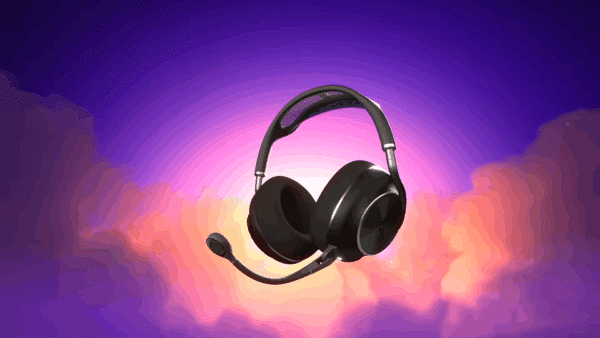
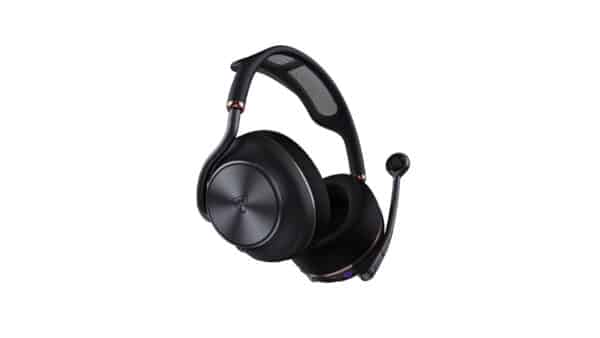
Weighing in at 301g / 0.66 lbs, the Atlas Airs are, well, light as air. The whole frame is plastic, however it’s whisper-quiet; I’ve yet to have heard a single creak or croak out of them. A floating inner headband is encased in a mesh wire, which helps to differentiate these headphones from all the other black designs out there. The left cup has all the headphone’s controls, including the always nice whole-cup wheel mechanism to control volume. The floating earcups also lend a signature look that helps to instantly distinguish the Atlas Airs in a sea of samey looks, with almost bungee cord-like straps holding the earcups in place. The earcups are wrapped in a mesh, athletic material which is highly breathable, allowing the memory foam within (which also has glasses-friendly ProSpecs tech for those that need more comfort with frames on) to dissipate heat more effectively. A snug fit is all but assured for most head sizes, and once you’ve been wearing them for a while, it’ll be easy to not feel them, even after longer gaming sessions.

New App to Control It All
The newly-released Swarm II app has been launched alongside Turtle Beach’s latest and greatest headphones and other hardware, and serves as a center point from where you can manage your connected Turtle Beach hardware, including customization and firmware updates. For the Atlas Air, you can modify EQ presets, and at least on Windows you can even set completely custom, 10-band levels for both playback and input. Unfortunately, the application is not available on Mac, but it is available on both iOS and Android, so if you have a smartphone it’s likely you can at least update these without issue. Here’s hoping Turtle Beach updates the mobile app to include the same EQ options as can be found on the desktop app soon.
Connectivity options are varied and numerous with the Atlas Air. The included proprietary USB transmitter can be plugged into most devices which sport that port, without much hassle. Range is incredible, as I was able to listen to my audio using this wireless mode at any spot in our two-story house which was built in the ’60s (so, thicker materials), without dropping so much as a single audio packet. In fact, for the highest-quality audio, this transmitter is required, as that is the only configuration in which these headphones will play the higher-fidelity 24-bit, 96 kHz bitstream. In an odd but perhaps economical exclusion, the Atlas Airs do not offer support for ANY high-resolution audio codecs over Bluetooth. No LDAC, aptX/HD, or anything like that. In a headset that purports to put audio quality first, this omission is a little perplexing, and slightly disappointing. But if you only plan on using these with the included transmitter, then this is really a non-issue.

A Unique Audio Experience
Open back headphones are a peculiar type of headphones. Traditional headphones are closed-back, and offer some natural muffling of the outside world, while many headsets offer noise cancelation in an attempt to put you in a virtual sound box where you mostly just hear whatever it is you’re listening to, while the noises of the outside world fade into near nothingness. Open back headphones offer a different listening experience: they allow outside sound (and its corresponding air molecules) to enter your ears, which means you’ll continue to hear your surroundings alongside whatever you’re listening too. In exchange, however, the sound stage of your audio is widened, and recordings sound more “alive” as the sounds these headphones produce envelope your ears as if the actual instruments were in the same room as you.
If it sounds too good to be true, well, there are naturally a few caveats. Not only can you hear your surroundings more easily, but people around you will also easily hear whatever these headphones are playing because they do not seal in much of the sound going in either direction. Using these on public transportation would probably be quite far from an ideal experience. But if you’re at home, in a relatively quiet room, or maybe in bed, the audio really does come alive.

Great Frequency Response, Long Battery Life
The earcups themselves help to achieve this liveliness. For starters, they have an expanded frequency response range of 20 Hz – 40 kHz, which is quite impressive considering they are smaller 40mm dynamic types. What this means in practical terms is that the Atlas Air headphones will not struggle with basically any audio you toss at them. Only sub-bass performance is a touch weak, but this isn’t something you’ll notice unless you’re listening critically. In day-to-day usage, these are phenomenal specifications.
Speaking of day-to-day, you can expect multiple days of battery life out of the Atlas Airs. Quoted at 50 hours, the 800 mAh battery seems to be just big enough to get you through a work week between charges, while not being so large that the headset starts to get a bit too heavy. Charging is done via any USB-C cable you’ve got lying around, and only takes a couple of hours to recharge.

Hear Your Surroundings
The Atlas Air headphones are a great fit for VR. Their natural openness helps to really sell the immersion of whatever game world you find yourself in, while the ability to more clearly hear your real-world surroundings can help to ensure you can hear if you are needed elsewhere. Their wireless compatibility also means you can play with one less cord dangling behind you, which can matter in VR. For regular gaming, those same connectivity options mean you can stay connected to your phone while you game, and the 3.5mm opens things up to the Xbox, older consoles, and other analog audio devices such as amps. The Atlas Air headphones are versatile, and beg to be experimented with.
Indeed, I’ve played around with these on a vacuum tube-enhanced amplifier, and enjoyed the extra oomph provided by the boosted signal. While the resistance rating of the Atlas Air is unknown as of this writing, they are easy to drive with anything you can connect them to. Your favorite album will open up to you if played on these headphones, as the wider, detailed sound stage allows instruments to position themselves precisely where the audio engineer placed them – as an example, Daft Punk’s Random Access Memories sounded rich and, much like I experienced with the higher-priced Audeze Maxwell, certain details within some of those tracks revealed themselves more distinctly than I remember from earlier listens with other traditional headphones. In other words, the Atlas Airs sound fantastic.
The included, detachable, unidirectional microphone is also great. It offers the satisfying flip-to-mute functionality that Turtle Beach and a few other brands are well known for, so it’s always physically obvious if you’re muted or not. 16-bit, 32kHz recording means your voice will be easily picked up in most environments, and when talking on the phone while testing these I never had any audio issues, and those on the other end of the line could hear me very clearly. There is no built-in mic, though, so if you take the boom mic off, you’re left with pure headphones without any sort of audio input capabilities.
Verdict
The Turtle Beach Atlas Air headphones have a lot of good things going for them. An expanded frequency response range means you’ll hear your in-game enemies before you see ‘em. Their open-back nature means you’ll have a better shot at hearing your real-life enemies before you see ‘em, as well (oh, and friends & family, too, then, I suppose). While the benefits to floating earcups is difficult to discern as there isn’t anything else quite like that out in the market, this is a unique driver type which provides for an audio experience you can’t currently find anywhere else. For some, that alone will be worth the reasonable asking price of $179.99 USD, and overall, we recommend the Turtle Beach Atlas Air headphones to anyone who cares about their gaming and personal audio quality.
Score: 9/10
Pros:
- Wonderful audio with a wide sound stage.
- Fantastic frequency response.
- Great battery life.
- Tons of connectivity options.
Cons:
- No lossless audio codec support over Bluetooth.
- Swarm II mobile app lacking EQ features seen on desktop app.
Turtle Beach Atlas Air review unit was provided by the manufacturer. You can read MP1st’s review and scoring policy right here.
This website contains affiliate links. If you click a link and make a purchase, we may earn a commission at no additional cost to you. This helps support our work. Learn more on our affiliate page.