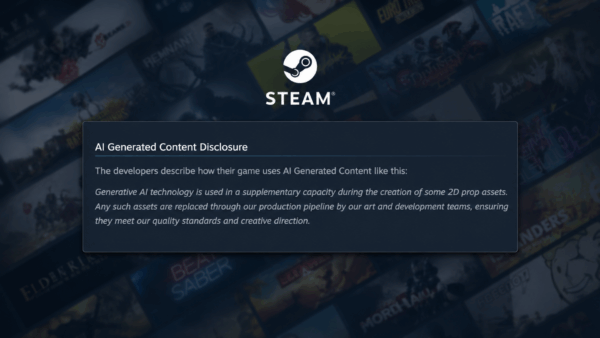
The Rise of AI Does Not Bode Well for Console and PC Gaming

I hate to be the doom-and-gloom guy, but things aren’t looking too good for the future of gaming as prices continue to rise, and it’s due to Artificial Intelligence (AI), which is something more and more game developers are relying on to speed up game creation, and also to save on manpower costs.
While AI might aid developers in releasing games faster, it is affecting game development negatively, and it’s not just on the creative side. Confused? Allow us to explain.
The Rise of AI is Killing Gaming, Not Just Creatively, But Also in Affordability

Over the last year, I’ve been looking at building a new PC. I can tell you from experience that the hobby can be rather expensive. Granted, I have always aimed for the higher end of specs, going for the top-of-the-line CPUs and the latest GPUs. It’s only expensive because I choose that route, and even then, I exercise caution when picking out components, making sure I get the best build possible, at the best (lowest) possible price. That usually involves waiting for deals to happen or understanding what kind of performance I’m paying for with X component and what that equates to in dollar terms, to help me make a “good” decision.
On the other hand, building a gaming PC is also pretty cheap if you aren’t aiming for the latest and greatest. Well, correction: it WAS pretty cheap up until the last few years, when AI really started to take off in the market.
NVIDIA first rolled out its DLSS tech with its RTX 2000 series cards in 2018. It was pretty limited back then, but it eventually ramped up in support when the RTX 3000 cards dropped, along with the newer DLSS revision.
At this point in history, the company was still pretty big on catering to gamers and pushing the envelope of technology to get better visuals and performance. It was right around the release of the RTX 4000, though, where prices were really starting to rear their ugly head, with the cost of performance being one of the worst we’ve seen. While the RTX 4090 offered that generational leap you’d hope for, going down the line, 4080, 4070, 4060, etc., the jump from the previous gen model wasn’t exactly significant to each counterpart, especially when you factored in the price of those cards. But it was with the RTX 4000 series cards that we saw Nvidia begin its big shift towards an AI-focused company.
Of course, this was in part due to the ongoing COVID-19 pandemic (2021-2023), which led to widespread shortages of goods worldwide. Electronics, though, specifically PC components, saw a massive surge in demand due to the isolation and such.
Coincidentally, cryptocurrency was becoming more “mainstream,” though it had already been surging in popularity in the years before. But the price of entry was still a relatively “low” one, especially for miners. That would lead to a worldwide shortage of GPUs, as both everyday consumers and companies would set up GPU farms to mine Bitcoin and other cryptocurrencies. As with the rule of supply and demand, the more demand there is, the less supply there will be, which means prices go up, and oh boy, did they go up.

It wasn’t just scalpers; even official GPU partners marked up the cost of their GPUs, with some local retailers, such as Microcenter, going above MSRP on multiple GPU lines. The moment a GPU listing went online, a scalper would instantly scoop it up, then turn around and mark the price up by nearly double. Things were looking pretty grim for the GPU market.
Yet, people still paid those prices, which might have led to Nvidia releasing their most expensive consumer GPUs yet, the RTX 5000 series cards. At this point, despite how expensive those cards are and the disappointment over the VRAM, it seems like people have “acclimated” to the prices. That, or they really did do a paper launch to drive up demand and price-gouge everyday consumers, to the point that finding a card at its MSRP is somehow considered to be a “deal.”
Mind, Nvidia wasn’t the only one to position their products beyond the realm of reasonable pricing. We’ve seen this happen with both AMD and Intel, and although they both offer cheaper lines of GPUs, price-wise, they’re still high up there, to the point that spending a few extra hundred dollars on a Nvidia GPU doesn’t look at all that bad. It all comes back to how much you’re getting for that price, making what should be an easy decision a rather complex one.

If you’ve been part of any PC-building community, you’ve likely noticed a growing sentiment around the hobby, which hasn’t been all that positive. AI is the big talk of the moment, with components getting even pricier while offering even less gains. “AI Tax,” as many would call it, is turning the hobby into an accessible DIY (do-it-yourself) adventure into a gated, luxury experience.
It’s getting to the point where it’s no longer about how much performance you want, but more so about how much you’re willing to shell out just to stay relevant enough. What used to be considered budget pricing has crept into the mid- to high-range, all because of the growing demand for AI.

That’s just for the PC side of things, too. Console gamers aren’t sheltered from rising prices, as this generation of consoles (PS5 and Xbox Series) has, for the first time in console history, seen prices increase rather than fall. Where, at what many consider to be the middle point of the generation, instead of becoming even more affordable, they have become more expensive. For once, being an early adopter actually saved some buyers money on hardware.
With things going at the rate, they are, it could mean a few things. The first and obvious, next-gen consoles are going to be very expensive. The thought of seeing another console priced over $600 was laughable a few years ago, yet that’s become a reality with today’s consoles. If gamers are expecting even more powerful consoles when next-gen arrives, the likelihood of them staying below that sweet spot of $500 are pretty slim.

The second, longer console generations. I’ll be honest, I barely feel like we’ve gotten our money’s worth out of the PS5 and Xbox Series X, and we are what, 5 years, coming up on 6, since they were released? Part of that is that we are still releasing games on last-gen (PS4 and Xbox One) platforms, but that right there should be enough to tell you where things are heading. We already had last-gen cycle extended, you can sure bet the PS5 and Xbox Series are going to be well supported into the PS6 and next Xbox generation.

That might sound like a win on paper, and sure, it can be. Who doesn’t want to get more out of their aging hardware? The machines we have today are very capable of delivering “next-gen” experiences. But at the same time, as demand for better visuals and performance continues to grow, the need for better hardware becomes increasingly apparent. With everyone so focused on AI, the innovation that we look forward to in every generation is no longer dictated by hardware, but by AI itself.
I’m not sure how that will look in terms of scalability, especially in the long term. However, I can’t imagine it will be good when developers use AI as a crutch to brute-force optimization rather than actually optimizing. I mean, it’s already happening, and all you have to do is look at Borderlands 4’s launch, a game that launched in such a poor state of optimization across even the highest of builds, with the studio’s head telling people to use the AI-powered tools their GPUs support.

Now, in some fairness, this isn’t to say that games ran flawlessly before the introduction of AI. We’ve always had poorly optimized games, but now there’s even more reason to continue that practice, given the belief that some tool will magically fix it.
Either way, even if the next-gen consoles were AI-heavy, I’m not expecting them to be cheap in any way. I remember when (still is) that was a big talking point for AI: making things easier, faster, and more affordable to produce. It could be true, for the business, but as for us consumers, we don’t see those savings. Nope, we see a worse product delivered at a higher cost. What is becoming of this industry?
The sad part of this whole thing is that consumer businesses are starting to move past their consumer fan base in the PC market.
There’s More Money Selling to AI-Powered Datacenters Than There Is From Gamers
Now I know what a lot of you are thinking, “Let’s all vote with our wallets, stop buying, that’ll show them!” Normally, I would agree with you all and be right there, even though chances are, a lot of us are going to stop spending so much on the hobby pretty soon anyway. The problem is, we, as gamers, are sadly no longer the market for the actual manufacturers that help build our PCs. Sure, we can stick it to the big three (Sony, Microsoft, and Nintendo) and some PC component makers. While they bring in a ton of revenue for chipmaker partners, the reality is that companies like Nvidia, AMD, and Intel are moving beyond everyday consumers.
You don’t need to take my word for it either, as Nvidia’s CEO, Jensen Huang, reminded us of that in their 2025 third-quarter earnings call when discussing how the company has evolved: “We have evolved over the past twenty-five years from a gaming GPU company to now an AI data center infrastructure company.” He continues, “Compute demand keeps accelerating and compounding across training and inference — each growing exponentially. We’ve entered the virtuous cycle of AI. The AI ecosystem is scaling fast — with more new foundation model makers, more AI startups, across more industries, and in more countries. AI is going everywhere, doing everything, all at once.”

Gamers are no longer the big focus for a company like Nvidia. A lot of PC gamers have already felt that too, with high-priced cards that offer little to no real price-to-performance boost over last-generation GPUs. The RTX 5000 series cards are outrageously expensive, and unless you go for the higher-end models, they often perform even worse than last-gen cards, and sometimes even worse than RTX 3000 series cards. For the price they’re asking for some of these cards, you’d expect them to be far outpacing the older ones. Their VRAM count has been very disappointing for this generation of cards, too.
While the RTX 2000, RTX 3000, and RTX 4000 lines of GPUs have AI features, I think many of us can agree that it was the RTX 5000 series that NVIDIA really started to show that they’re ready to “leave” gamers behind, with many of the buzzwords thrown around the series centered on AI. Go back and rewatch the RTX 5000 series reveal, and count how many times they say AI. It’s a lot, and looking back at it, from a gamer perspective, and seeing where we are now, it makes a lot of sense why they said it so many times.
But the point is, voting with our wallets in this case is probably futile, especially since the market is already doing that for us. Look at the price of DDR5 RAM. We went from being able to get 32GB (2x16GB) for $100-$200 to prices now being $300-$500 and more. Think about that: RAM costs almost as much as buying a gaming console. It’s not like the everyday consumer is rushing out to purchase RAM at these prices either. It’s targeting those in the field of AI, with a bulk of the RAM likely bought by big businesses. It’s 2021 again, but instead of GPUs, it’s RAM, and instead of Crypto and COVID-19, it’s datacenters and their push for AI. These are being bought not as a single item for a single gaming PC, but in bulk to power hundreds, maybe even thousands, of machines.
If you needed any proof of how outrageous the pricing has gotten, here are two RAM kits I bought earlier last year at Microcenter, and what they cost today.

That’s a 394.67% price increase (off the current MSRP before discount) for this stick of RAM. Now, let’s look at the next one, which was pricier at the time of purchase.

A whopping 470.20% price increase in less than a year. This stick alone costs just as much as a PS5 Pro. Disgusting. I cannot imagine anyone willing to pay these prices, but I know they’re out there. It does make owning a console and paying that price easier to swallow, but come on, do we really need to keep repeating this cycle of acceptance?
DDR4 prices are also increasing, but in all fairness, this is partly due to the common trend of last-gen RAM winding down production: as supply runs low and demand remains high, prices begin to rise. We saw it was DDR3 when everything started moving to DDR4, and now we’re seeing it with DDR4 as everything shifts to DDR5. But with the growing demand for RAM, some companies are now pushing their end-of-life plans, like Samsung, which recently extended its support for DDR4. If they haven’t already, DDR4 prices are about to go up, too.

Every component that goes into a PC is seeing a price increase, with perhaps the exception of a few things like PSU and Motherboards. The latter has seen a price reduction, though considering the cost of RAM and other components, those savings quickly disappear.
These aren’t prices advertised to us; they’re prices advertised for the mega corporations that don’t care how much they have to spend. It’ll all (at least some of it) fall under a tax write-off anyway, but seeing these prices really shows the shift: we’re no longer the target market.
If you needed a real eye-opener, just look at the recent CES (Consumer Electronics Show) 2026 panel featuring NVIDIA, AMD, and Intel.
Very AI-heavy, with a focus on data centers and on selling products built specifically for them. AMD announced a new CPU, the 9850X3D, but not at the show itself. A consumer product, skipping out on a consumer showcase, so that they could bring up top names in the AI space. Nothing screams consumer-friendly more than bringing in the White House director of science and technology policy to discuss how they’re going to bring the tech to other big companies and ensure they benefit from it through regulations made for them. If you think that’s ridiculous, AMD then invites members of the health system to discuss their endless fight against male baldness.
Ah, yes, this is exactly the kind of content I was expecting from a consumer electronics show. Sure, you might say, “You’re missing the bigger picture here!” Really? Did we watch the same show? You know, the one where even some of these tech giants were fumbling to explain what AI is even doing for us, resorting to throwing around the same buzzwords that mean nothing, and elaborating on the benefits of AI by regurgitating things that even make people question it? The same show where you can even see AMD’s CEO cut off one of these health experts as they begin to trail off with the excitement about AI immortality?
AMD even joked with another AI company, where they came to the AMD office and filmed without permission. Obviously, they had it, but let’s take a jab at the biggest issue in the community around AI: stealing and creating slop and calling it your own. But that’s OK with AMD, and therefore, the industry should be OK with it too.
Surely, I’m being punked here? Tell me that Ashton Kutcher is going to pop behind the curtain with his big dumbass smile, to say we’re all getting punked? No? Well fuck.
On the bright side, people in the PC space don’t forget. If the AI bubble ever pops and things return to a consumer-focused space, the few companies that are packing it in now to focus on selling to these big companies likely won’t be welcomed back with open arms. Micron’s announcement of its exit from the consumer business to focus on data centers won’t be something many consumers will forget.
“The AI-driven growth in the data center has led to a surge in demand for memory and storage. Micron has made the difficult decision to exit the Crucial consumer business in order to improve supply and support for our larger, strategic customers in faster-growing segments,” said Sumit Sadana, EVP and Chief Business Officer at Micron Technology.
Abandoning your customers is undoubtedly a great way to build and maintain a good public image.

But the Investors Are Telling Us AI Is the Future!
Just a few days ago, Google announced Project Genie, its newest AI-driven tool that lets users build and explore 3D worlds with just text prompts, all in real time.
This news sent a shockwave through the industry, especially among investors, who saw a large sell-off in gaming stocks from the likes of CD Projekt Red, Take-Two, Unity, Roblox, and many others.
I don’t want to dwell on this, but I do want to point out that the dips in stocks probably shouldn’t be much of a concern for many. From the public view, it looks like investors are swaying away from gaming studios and heading to more AI-focused companies. I don’t buy that. At least, in the sense that the dips are an indicator of lost faith, and they are running elsewhere. The likelihood of those stockholders already being invested in AI is already pretty high, and even higher than they were long-term holders.
So, the sell-off is probably more so knowing that the dip was going to happen, and what a better buying opportunity it’s going to be for these same investors, after they’ve sold off a percentage of their stocks for high gains, and can now buy back in, at a lower cost, and make even more gains. Plus, this doesn’t even include the ongoing market trends that are affecting nearly every facet of the stock market. It’s just that many of us are looking at gaming-specific news, not realizing what else is going on in the stock market.
Investors are being bearish right now, protecting their own assets. In the world of investing, cash is king, and it’s the only asset worth protecting. I’m positive we’re going to see a massive bounce back in these stocks, s too. Sell high, then wait long enough for the floor to settle down to re-invest again. It’s a gamble, but it’s what investors do. Personally, I feel that whenever we (as in gaming websites) write about it, it’s just doom and gloom without actually understanding how it works. We tend to mix financial strategies with existential crises and see dips as the end for the sake of clicks (I am aware of the irony here).
As much as I hope AI doesn’t become integral in the workflow of these massive gaming giants, we all do have to remember that they are the ones who have the most to gain from it. But the realization is that the industry runs on talent and creativity, and these massive giants wouldn’t be there without all those talented people. If investors actually believe that AI is going to replace those very people, just because they saw some AI-generated GTA slop, then maybe they are as big as idiots everyone is claiming them to be.

I don’t buy that, though. It’s easy for us to think that, but it’s their job to make money, and selling is them playing it safe and smart, especially if there’s potential for even more money when you buy back in later.
Look at Take Two, for example. Its stock price is still insanely high, but over the last year, it has reached all-time highs and experienced big dips. Websites that write about Take-Two stock dips should feel like déjà vu because they wrote about it the other three big times it has happened, and you know what happens a few weeks later? It’s back up. I’m not saying Take-Two and these other companies will always rebound. I’m just pointing out that gaming sites have written so much about the dips that it’s starting to feel like the boy who cried wolf. Treating market volatility like the end provides easy engagement. Market corrections are a thing, and everything can’t remain at a high forever.
The Biggest Lie

So why the big push for AI? Well, according to many of its supporters, AI is supposed to make things better across the board. Companies are supposed to have better workflows, be more efficient, have faster development cycles, and ultimately lower costs. By reducing overhead, we’re led to believe things will be better for both consumers and employees.
In an ideal world, sure, this would probably be the case for many fields, with everyone, including consumers, benefiting from the innovation AI brings. But over time, we’ve seen the push in AI continue to grow, leading to mass layoffs, price increases, and a noticeable shift in priorities away from the end user. AI isn’t making things cheaper, at least for us, because everything is getting pushed further up the price ladder. What AI is doing is producing record profits for these big AI-supporting companies, while leaving everyone else, including their employees, to foot the bill to get them there.
If AI is so great, so revolutionary in the way we do work, to the point that it can cut it to a fraction of the time, then why are prices being driven up, hardware getting more expensive, and workers still being underpaid while forced into crunch? Everyone knows the answer, and this facade isn’t fooling anyone. This was always about making money, and never about giving consumers any real benefits. I’m not saying that AI doesn’t have a place in gaming. I do think it does, but like so many other potentially good things out there, the first thing that comes to mind is exploitation.
It was never about making things better for us, consumers and workers, but rather about maximizing profit margins. Just remember, a few years ago, before AI was starting to explode, and game prices were increasing, it was all about how expensive things had become to make. Now it’s cheaper for some of these companies, yet none of that savings is ever passed down to consumers.
With talk of $100 games being a possible reality and hardware costs rising, I have a feeling we haven’t seen the worst of it. 2026 is going to be a very interesting year for the market, and something tells me it’s going to force more and more gamers to decide whether this hobby is still worth investing in, or if it’s finally time to hang up that controller.
I don’t like to be the doom-and-gloom guy, like, at all. We’ve heard this tale far too many times, and perhaps it’s been a long warning in the industry, with talks of “this being the last generation” happening every generation. I firmly believe gaming will continue to exist. It’s not going anywhere, but given the trajectory of where things are heading, there needs to be a significant change for it to remain affordable for the masses.
Gaming isn’t going to die, but I’m expecting it to be very different in the next decade.

This website contains affiliate links. If you click a link and make a purchase, we may earn a commission at no additional cost to you. This helps support our work. Learn more on our affiliate page.